

Is There a Chlorpyrifos Parkinson’s Disease Lawsuit?
Chlorpyrifos lawsuits are being pursued for individuals nationwide who developed Parkinson’s disease after exposure to Dursban, Lorsban and other chlorpyrifos insecticides. The claims follow emerging research identifying chlorpyrifos as a specific environmental risk factor for the neurological disorder.
For many individuals, the exposure occurred years or even decades before Parkinson’s disease was diagnosed. Potential claims may involve people who directly mixed or sprayed chlorpyrifos, lived in homes treated with insecticides, worked around pesticide applications on farms, construction sites or golf courses, or served in the military during the First Gulf War between 1990 and 1992, when the pesticide was heavily used.
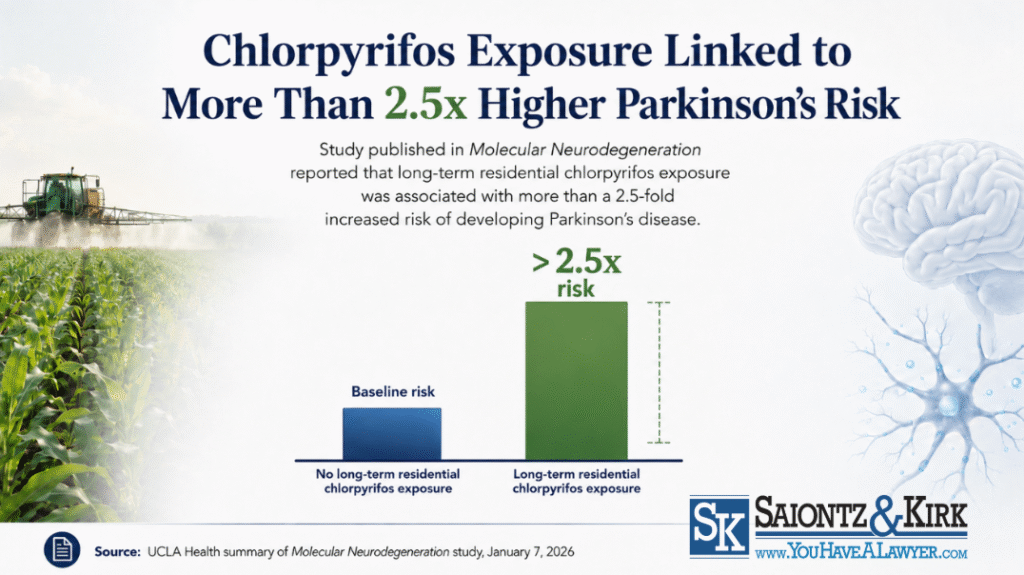
That broad range of potential exposures has become especially significant in light of recent research indicating that individuals with routine chlorpyrifos exposure faced more than 2.5 times the risk of developing Parkinson’s disease.
Based on those findings, chlorpyrifos lawsuits allege that manufacturers failed to adequately investigate the pesticide’s long-term effects on the brain and did not warn that exposure could contribute to the neurological damage associated with Parkinson’s disease.
Our chlorpyrifos injury lawyers are evaluating claims against Corteva, Dow Chemical, FMC and other companies involved in manufacturing and selling chlorpyrifos products. All cases are handled on a contingency fee basis, which means there are no out-of-pocket costs to hire our chlorpyrifos lawyers, and we receive no fees or expenses unless a settlement or recovery is obtained.
Who Can File a Chlorpyrifos Lawsuit?
Saiontz & Kirk is pursuing chlorpyrifos exposure lawsuits for any of the following individuals diagnosed with Parkinson’s disease:
- Farmers and farm laborers who mixed or sprayed pesticides, entered treated fields or experienced repeated insecticide drift.
- Pest control technicians and exterminators who regularly handled Dursban or other chlorpyrifos products.
- Pesticide mixers, loaders and applicators who prepared concentrated chemicals or operated spraying equipment.
- Homeowners, renters and family members who were inside a residence where insecticides were sprayed or termite treatments were performed.
- Construction workers who were present when pesticides were applied to soil, trenches, foundations or building perimeters
- Golf course groundskeepers, landscapers and maintenance employees who repeatedly worked around insecticide applications or treated turf.
- Nursery and greenhouse workers who handled treated plants, soil, tools or spraying equipment.
- Chemical plant, warehouse and distribution workers who handled chlorpyrifos products or contaminated containers.
- Gulf War veterans who were later diagnosed with Parkinson’s disease after serving in areas where insecticides were used for pest control
If you or a loved one developed Parkinson’s Disease after being exposed to pesticides, you may be eligible for a chlorpyrifos lawsuit settlement. Contact our chlorpyrifos lawyers today for a free case evaluation.

2026 Chlorpyrifos Lawsuit Update
Chlorpyrifos Parkinson’s disease lawsuits began emerging in 2026, following new research linking long-term exposure to the pesticide with more than a 2.5-fold increased risk of developing Parkinson’s disease. The litigation remains in its early stages, but additional claims are expected as farmers, workers, residents and veterans learn that past insecticide exposure may have contributed to their diagnosis.
The initial lawsuits allege that chlorpyrifos manufacturers failed to adequately investigate the long-term neurological effects of the pesticide, despite knowing that it directly interferes with the nervous system. The claims maintain that Dursban, Lorsban and other chlorpyrifos products were sold for decades without warnings that exposure could damage dopamine-producing brain cells and increase the risk of Parkinson’s disease.
As of September 2026, no nationwide chlorpyrifos litigation or coordinated federal proceeding has been established. Saiontz & Kirk is investigating individual Parkinson’s disease claims involving direct pesticide use, residential spraying, agricultural exposure, construction and golf course work, and military service during the Gulf Wars.
Chlorpyrifos Lawsuit Info On This Page
Chlorpyrifos Products Named In Lawsuits
Who May Have Been Exposed
How Can Chlorpyrifos Cause Parkinson’s Disease?
Chlorpyrifos Parkinson’s Disease Side Effects and Symptoms
Regulatory Actions Involving Chlorpyrifos
Chlorpyrifos Lawsuit Allegations
Potential For Chlorpyrifos Lawsuit Settlements
Are There Any Costs to Hire a Chlorpyrifos Lawyer
Chlorpyrifos Lawsuit FAQs
What Chlorpyrifos Products Are Involved?
Chlorpyrifos was sold under numerous trade names for agricultural, residential and commercial pest control. The product involved in a claim may depend on the individual’s occupation, location and years of exposure.
- Dursban: Manufactured and sold by Dow and related companies for residential, structural and commercial pest control, including indoor insect treatments, lawns, ornamental plants, building perimeters and termite applications.
- Raid: Certain historical Raid-branded insecticides manufactured by S.C. Johnson contained chlorpyrifos and were marketed for household and outdoor insect control. Because Raid formulations varied over time, only products specifically containing chlorpyrifos would be relevant to a claim.
- ORTHO Home Pest Insect Control: An ORTHO-branded residential insecticide that contained chlorpyrifos and was marketed for indoor and outdoor household pest control. Historical EPA records identify Chevron Chemical Company’s Ortho Consumer Products Division and, later, The Solaris Group of Monsanto Company in connection with the product.
- ORTHO-KLOR Soil Insect & Termite Killer: An ORTHO-branded concentrated chlorpyrifos insecticide used for residential and structural pest control, including applications around buildings, foundations, lawns and other outdoor areas. Historical EPA records identify The Solaris Group of Monsanto Company in connection with the product.
- Lorsban: Manufactured and sold by Dow and related companies primarily for agricultural use on crops, foliage and soil. Workers often encountered Lorsban while measuring concentrates, filling tanks, spraying fields and cleaning equipment.
- Cobalt: A Dow agricultural insecticide containing chlorpyrifos that was applied to crops to control a broad range of agricultural pests.
- Nufos: A chlorpyrifos agricultural insecticide sold by Cheminova and later associated with FMC for use on crops and soil.
- Bolton: A chlorpyrifos insecticide registered by Cheminova and later associated with FMC for agricultural insect control.
- Stallion: An FMC agricultural insecticide containing chlorpyrifos that was used to control crop-damaging insects.
- Lock-On: A chlorpyrifos agricultural insecticide marketed for controlling insects affecting crops and treated soil.
- Warhawk: A chlorpyrifos agricultural insecticide marketed by Loveland Products for controlling crop pests through foliar and soil applications.
Additional chlorpyrifos products were sold under other names. Individuals should not assume they are ineligible because they cannot remember the exact brand used decades ago. Employment records, application logs, invoices, pest-control records and historical pesticide labels may help identify the product involved.
Who May Have Been Exposed to Chlorpyrifos?
Chlorpyrifos exposure was not limited to workers who personally sprayed pesticides. Depending on where and how the insecticide was used, people may have inhaled spray, absorbed residue through their skin or worked in areas treated shortly before they arrived.
Common Chlorpyrifos Exposures
- Farmers and agricultural laborers who mixed or sprayed insecticides, entered treated fields, handled crops or worked downwind from pesticide applications.
- Pesticide mixers, loaders and applicators who measured concentrated chemicals, filled tanks, operated spraying equipment or cleaned contaminated containers.
- Pest control technicians and exterminators who applied Dursban, ORTHO-KLOR or other chlorpyrifos products inside homes, around foundations or during termite and structural pest treatments.
- Homeowners, renters and household residents who were exposed to chlorpyrifos-containing household insecticides, including certain Raid and ORTHO products, or who lived in homes where insecticides were sprayed or termite treatments were performed.
- Construction and excavation workers who worked around soil, trenches, foundations or building perimeters treated with insecticides.
- Golf course groundskeepers and maintenance workers who mixed pesticides, worked near active spraying or maintained recently treated turf.
- Landscapers who handled treated soil, plants, tools or equipment or worked near insecticide applications.
- Nursery and greenhouse employees who sprayed plants, handled treated vegetation or worked in enclosed areas where pesticides were used.
- Chemical plant and warehouse workers who manufactured, packaged, stored or transported chlorpyrifos products.
- Equipment maintenance workers who cleaned or repaired pesticide tanks, pumps, hoses, sprayers or machinery carrying chemical residue.
- Gulf War veterans who served in areas where insecticides were used around bases, encampments, sleeping areas and military facilities.
The exposure history required to support a claim depends on the setting. Direct users generally need repeated contact with a known chlorpyrifos product, while residential claims may involve indoor spraying or termite treatment and military claims may be evaluated through service and deployment records.
How Can Chlorpyrifos Cause Parkinson’s Disease?
Parkinson’s disease develops as dopamine-producing neurons in the brain become damaged and die. These cells are essential for controlling movement, balance and coordination, and their gradual loss produces the characteristic symptoms of Parkinson’s disease.
One of the most significant studies supporting the link between chlorpyrifos and Parkinson’s disease was published in the medical journal Molecular Neurodegeneration, indicating that individuals with long-term residential chlorpyrifos exposure had more than 2.5 times the risk of developing Parkinson’s disease compared with those without that exposure.
The chlorpyrifos litigation is also supported by a growing body of research examining both the increased risk of Parkinson’s disease and the biological mechanisms through which the pesticide may damage the brain, including:
- Loss of dopamine-producing brain cells: In the same Molecular Neurodegeneration study, mice exposed to aerosolized chlorpyrifos developed movement problems and lost dopamine-producing neurons, the same type of cells that progressively die in individuals with Parkinson’s disease.
- Brain inflammation and alpha-synuclein buildup: Researchers also found increased brain inflammation and abnormal accumulation of alpha-synuclein, a protein that forms the characteristic clumps found in Parkinson’s disease.
- Failure of the brain’s cellular cleanup system: Zebrafish experiments indicated that chlorpyrifos disrupted autophagy, the process brain cells use to remove damaged proteins and other cellular waste. Restoring that process or removing synuclein protected the neurons from damage, providing a potential explanation for how chlorpyrifos may trigger progressive neurodegeneration.
- Oxidative stress and mitochondrial damage: Laboratory research has found that chlorpyrifos can generate reactive oxygen species and interfere with mitochondrial function. These effects may deprive neurons of energy while increasing cellular damage, two mechanisms strongly associated with neurodegenerative disease. (Food and Chemical Toxicology and Toxicology and Applied Pharmacology)
- Changes involving dopamine levels and neuron genes: Animal research found that repeated developmental chlorpyrifos exposure altered striatal dopamine levels and affected the expression of genes involved in dopamine-neuron function. The striatum is a brain region that depends heavily on dopamine to regulate movement. (Neurotoxicol Teratol)
- Changes in genes associated with Parkinson’s disease: Earlier cell research found that chlorpyrifos altered the expression of genes associated with Parkinson’s disease, adding evidence that organophosphate exposure may interfere with pathways involved in neurodegeneration. (Brain Research Bulletin)
- Damage to structures associated with Parkinson’s disease: Additional animal research found chlorpyrifos-related changes involving the substantia nigra and markers tied to dopamine-producing neurons. The substantia nigra is the area of the brain most severely affected by Parkinson’s disease. (Experimental Brain Research)
- Persistent neurological effects among exposed workers: Occupational research has also examined long-lasting neurobehavioral problems among workers exposed to chlorpyrifos, including difficulties involving memory, attention, mood and motor function. (Neurotoxicology)
Taken together, these studies provide several layers of evidence supporting the chlorpyrifos Parkinson’s lawsuits. Human research identifies a substantially increased Parkinson’s disease risk, while animal and cellular studies show how chlorpyrifos may damage dopamine-producing neurons through inflammation, oxidative stress, mitochondrial dysfunction, impaired cellular cleanup and abnormal protein accumulation.
Chlorpyrifos Parkinson’s Disease Side Effects and Symptoms
Parkinson’s disease is a progressive neurological disorder. Symptoms of Parkinson’s caused by chlorpyrifos may initially be mild or limited to one side of the body, but typically become more severe as additional dopamine-producing neurons are lost.
Common movement-related symptoms include:
- Resting tremors
- Slowed movement
- Muscle stiffness
- Shuffling gait
- Freezing while walking
- Balance problems
- Stooped posture
- Reduced arm movement
- Difficulty turning or changing direction
- Muscle spasms
- Reduced facial expression
- Small or cramped handwriting
- Quiet or slurred speech
- Difficulty swallowing
Parkinson’s disease can also cause serious non-movement symptoms, including:
- Loss of smell
- Constipation
- Sleep disturbances
- Depression
- Anxiety
- Fatigue
- Memory problems
- Cognitive decline
- Low blood pressure when standing
- Urinary problems
There is no cure for a chlorpyrifos Parkinson’s disease diagnosis. Although medications and therapy may help control symptoms, many individuals eventually require mobility equipment, home modifications, help with daily activities or full-time care.
Regulatory Actions Involving Chlorpyrifos
Federal regulators have restricted chlorpyrifos for more than two decades because of concerns involving residential exposure, children, agricultural workers, spray drift, food residues and nervous-system effects.
- 2026 — Federal review continues: Chlorpyrifos remains under EPA registration review while the agency considers further action involving its remaining human-health and environmental risks.
- 2024 and 2025 — EPA again moved to eliminate most food uses: The EPA issued cancellation orders affecting additional chlorpyrifos products and proposed retaining tolerances for only 11 crops. The agency estimated that the proposed restrictions could reduce average annual chlorpyrifos use by approximately 70%.
- 2023 — Court reinstated the tolerances: A federal appeals court vacated the 2021 rule and returned the matter to the EPA. The former food tolerances were subsequently reinstated.
2021 — Food tolerances revoked: The EPA issued a final rule eliminating all chlorpyrifos tolerances on food and animal-feed crops, effectively stopping those uses. - 2015 — EPA proposed ending all food uses: The agency proposed revoking every chlorpyrifos food tolerance after determining that it could not make the legally required finding that existing uses were safe.
- 2012 — Agricultural protections strengthened: The EPA significantly reduced certain aerial application rates and established no-spray buffer zones around homes, schools, sidewalks, recreational areas and other sensitive locations.
- 2000 — Most residential uses eliminated: Chlorpyrifos manufacturers agreed to remove nearly all homeowner uses, including most indoor sprays, lawn treatments and termite applications in completed homes.
These actions did not directly determine whether chlorpyrifos causes Parkinson’s disease. However, lawsuits may point to this history as evidence that serious concerns involving neurological toxicity, residential exposure and worker safety existed long before users received warnings about a potential Parkinson’s disease risk.
Chlorpyrifos Lawsuit Allegations
Chlorpyrifos lawsuits allege that pesticide manufacturers sold Dursban, Lorsban and other products without adequately warning that exposure could increase the risk of Parkinson’s disease. The claims maintain that manufacturers:
- Failed to adequately study long-term exposure among adults
- Failed to investigate the connection between chlorpyrifos and Parkinson’s disease
- Sold an unreasonably dangerous pesticide
- Failed to provide adequate neurological warnings
- Minimized or concealed evidence of neurotoxicity
- Marketed chlorpyrifos products as safe for foreseeable uses
- Relied on incomplete or misleading safety research
- Failed to report relevant health information
- Continued selling chlorpyrifos despite safer alternatives
- Failed to recommend adequate precautions for workers and consumers
Individuals pursuing lawsuits may seek compensation for medical expenses, lost income, reduced earning capacity, permanent disability, pain and suffering, diminished quality of life and future care needs.
Potential For Chlorpyrifos Lawsuit Settlements
While no chlorpyrifos Parkinson’s disease settlements have been publicly announced, and the litigation remains in its earliest stages, the history of similar litigation involving Paraquat Parkinson’s disease lawsuits provides a useful example of how herbicide and pesticide claims involving a progressive neurological injury may develop as additional lawsuits are filed.
The Paraquat litigation began with individual lawsuits alleging that manufacturers failed to warn farmers and agricultural workers that repeated herbicide exposure could increase the risk of Parkinson’s disease. As the number of federal claims increased, the U.S. Judicial Panel on Multidistrict Litigation established Paraquat MDL No. 3004 on June 7, 2021, transferring the lawsuits to the Southern District of Illinois for coordinated discovery and pretrial proceedings before U.S. District Judge Nancy J. Rosenstengel. At that time, 77 filed cases and potential tag-along actions were pending across 16 federal districts.
The Paraquat MDL ultimately grew to include thousands of Parkinson’s disease lawsuits involving common questions about product warnings, scientific evidence, exposure histories and the manufacturers’ knowledge of the alleged neurological risks.
Paraquat Herbicide Global Settlement Reached
In April 2025, the federal court overseeing the Paraquat MDL was advised that the parties had reached a global settlement. Case deadlines were stayed while attorneys finalized the agreement and began presenting individual settlement offers to eligible plaintiffs.
By June 2026, the court indicated that many Paraquat plaintiffs had accepted settlement offers, although others elected to opt out and continue pursuing their lawsuits. The exact settlement amounts each individual diagnosed with Parkinson’s disease received will vary greatly based on criteria and the impact of the disease. However, the manufacturers will pay hundreds of millions in Parkinson’s disease lawsuit payouts to resolve the Paraquat litigation.
Could Chlorpyrifos Lawsuits Lead to a Similar Settlement?
The Paraquat agreement does not establish what chlorpyrifos lawsuits may be worth. The products, manufacturers, scientific evidence and exposure requirements are different. However, it demonstrates how thousands of individual Parkinson’s disease claims may eventually be coordinated and resolved through a settlement program while preserving the right of some plaintiffs to reject an offer and continue litigating.
How Much Is a Chlorpyrifos Lawsuit Settlement Worth?
Any future chlorpyrifos settlement negotiations will depend on multiple factors, including:
- The type, duration and frequency of the chlorpyrifos or insecticide exposure;
- Whether Dursban, Lorsban or another chlorpyrifos product can be identified;
- The strength of employment, residential, military or pesticide application records supporting the exposure history;
- The age of the individual when Parkinson’s disease was diagnosed;
- The severity and progression of the Parkinson’s disease symptoms;
- The amount of any past and future medical expenses;
- The amount of any lost wages or loss of future earning capacity;
- The need for mobility equipment, home modifications, in-home assistance or full-time care;
- The impact Parkinson’s disease has had on the individual’s independence, physical health and overall quality of life;
- The past and future pain, emotional distress and mental anguish suffered by the individual;
Are There Any Costs to Hire a Chlorpyrifos Lawyer
There are absolutely no out-of-pocket costs to review your case or hire our attorneys. Potential claims are evaluated for individuals throughout the United States, and all cases are handled on a contingency fee basis.
Through the use of contingency attorney fees, individuals have access to the experience and resources of our national law firm for their chlorpyrifos Parkinson’s disease lawsuit — regardless of their individual financial resources.
You pay nothing up front to hire our lawyers, and we only receive an attorney fee or expenses out of the money that is obtained from the pesticide manufacturers. Our law firm receives nothing unless we win your case!
What are the steps in a chlorpyrifos case evaluation?
Complete Our Case Evaluation Request Form. Provide your contact information, Parkinson’s disease diagnosis and details about where and how you were exposed to chlorpyrifos or other insecticides.
Get Contacted by Saiontz & Kirk. You will be contacted by our law firm to discuss your exposure history and help determine whether financial compensation may be available for you and your family.
You Decide If You Want to Move Forward. If our lawyers determine that we can help with your case, then you decide whether to move forward and hire us to pursue compensation.
FIND OUT IF YOU QUALIFY FOR A CHLORPYRIFOS LAWSUIT SETTLEMENT
Chlorpyrifos Lawsuit FAQs
Do I need a formal Parkinson’s disease diagnosis?
Yes. A formal Parkinson’s disease diagnosis is generally required to pursue a chlorpyrifos lawsuit. Tremors, stiffness, balance problems or other symptoms alone are not currently sufficient without a medical diagnosis.
How do I know whether I was exposed to chlorpyrifos?
Many people were exposed years ago and may not remember the chemical name. Exposure may be identified through product names, job duties, spraying equipment, crops or property treated, employer records, application logs, pest-control invoices, military records and witness statements.
Do I need to remember the exact pesticide brand?
Not necessarily. Saiontz & Kirk may investigate whether Dursban, Lorsban Raid, ORTHO or another chlorpyrifos product was used based on employment records, purchasing histories, pesticide labels, treatment invoices and statements from coworkers or family members.
Can exposure inside a home support a chlorpyrifos claim?
Potentially. Residential claims may involve individuals who lived in or were present inside a home where an insecticide was sprayed or a termite treatment was performed, particularly before most residential chlorpyrifos uses ended in 2000.
Can farm workers file chlorpyrifos lawsuits?
Farmers and agricultural workers may qualify after directly mixing or applying chlorpyrifos or experiencing repeated exposure to spraying, drift, treated crops, soil or contaminated equipment.
Can construction workers qualify for a chlorpyrifos lawsuit?
Construction workers may qualify if they repeatedly worked around insecticides applied to soil, trenches, foundations, crawl spaces or building perimeters for termite and pest control.
Can golf course workers file a chlorpyrifos lawsuit?
Groundskeepers, landscapers and maintenance employees may qualify after repeated exposure to pesticide spraying, drift or residue on treated turf and landscaping. Recreational golfing alone is not currently enough to support a claim.
Can Gulf War veterans file a chlorpyrifos lawsuit?
Gulf War veterans diagnosed with Parkinson’s disease may qualify even if they do not remember a particular pesticide brand or individual spraying event. Military service, deployment and historical pesticide-use records may be reviewed to investigate exposure.
How many times must someone have been exposed?
The exposure requirement depends on the circumstances. Direct users and individuals exposed through farm, construction or golf course work generally need a history of repeated exposure, while residential claims may involve an indoor spraying or termite treatment.
Could chlorpyrifos exposure from decades ago still support a lawsuit?
Yes. Parkinson’s disease may be diagnosed years after the pesticide exposure occurred. Lawyers may use historical employment, residential, military and pesticide-use records to investigate older exposure.
What evidence is needed for a chlorpyrifos lawsuit?
Helpful evidence may include medical and neurology records, employment history, Social Security earnings records, pesticide applicator licenses, application logs, employer invoices, pest-control records, product photographs, coworker statements and military records.
Real results. Real reviews.
Here’s what our clients have to say.
