
Nevro and Abbott Spinal Cord Stimulator Lawsuits Centralized in Separate Federal MDLs
Individuals who suffered shocks, worsening pain, lead problems or removal surgery after receiving Abbott or Nevro spinal cord stimulators may be able to pursue claims.

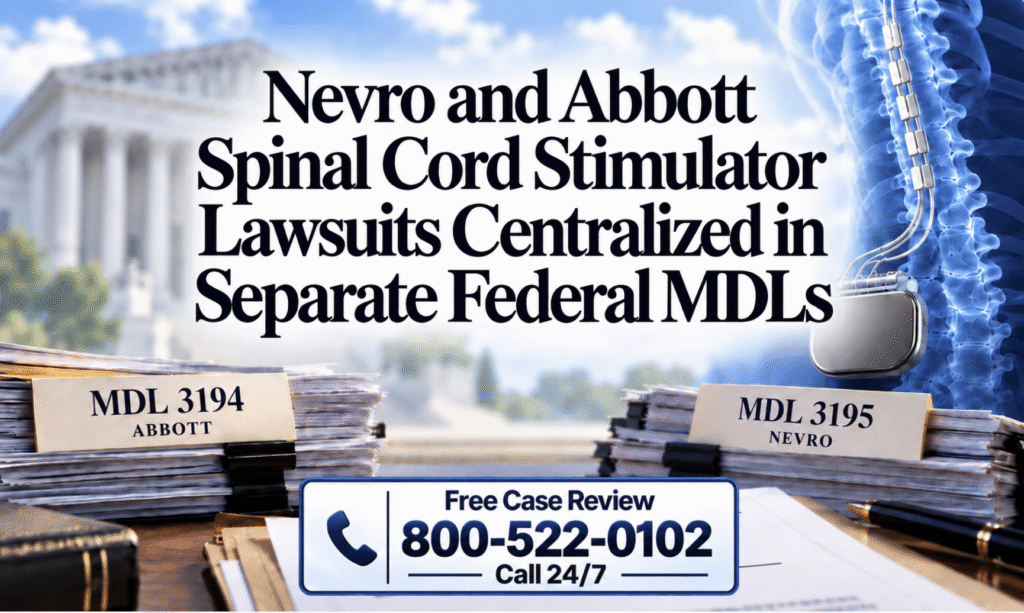
Abbott and Nevro spinal cord stimulator lawsuits will now move forward in two new federal MDLs, after the U.S. Judicial Panel on Multidistrict Litigation agreed to centralize claims filed by individuals who say the implanted pain devices failed, malfunctioned or caused serious injuries.
Over the past year, a rapidly increasing number of spinal cord stimulator lawsuits have been filed by individuals who received implanted pain management devices that were supposed to provide long-term relief, but instead caused new or worsening complications. The complaints allege certain devices failed to work as intended, delivered painful stimulation, lost therapy, developed lead problems or required revision or removal surgery.
Request a Free Claim Review by a SPINAL CORD STIMULATOR LAWSUIT

Much of the litigation is focused in the federal court system, where dozens of Boston Scientific spinal cord stimulator lawsuits were previously centralized before one judge in June 2026. However, at that time, the JPML declined to create one industry-wide MDL and only included claims filed against that one manufacturer were impacted.
As a growing number of Abbott lawsuits and Nevro lawsuits have continued to be filed over the past few months, the JPML has now agreed to establish separate centralized proceedings for lawsuits involving products made by these competing manufacturers. This will allow similar cases involving the same company to proceed through discovery, motions and other pretrial matters more efficiently.
Across these cases, lawsuits contend that patients and their doctors were not fully warned about the risk of experiencing spinal cord stimulator problems and complications, including:
- Loss of pain relief;
- Painful electrical shocks;
- Burning or stabbing sensations;
- Muscle spasms or involuntary movements;
- New or worsening back, leg or nerve pain;
- Revision surgery or complete removal of the device.
In this post, we will explain the importance of this new development in the spinal cord stimulator litigation, why Abbott and Nevro SCS lawsuits were centralized in separate MDLs, what that means for individuals pursuing claims across the U.S., and the impact this may have on future bellwether trials and spinal cord stimulator settlement negotiations in each MDL.
If you have any further questions or concerns, please do not hesitate to contact our spinal cord stimulator lawyers at Saiontz & Kirk, who are continuing to investigate new claims for individuals who suffered injuries or complications after receiving an Abbott, Nevro, Boston Scientific or Medtronic device. Call us toll free at 1-800-522-0102 or complete our free case review form today to find out whether you may qualify for a lawsuit.
What Is a Spinal Cord Stimulator MDL?
A spinal cord stimulator multidistrict litigation, commonly referred to as an MDL, is a federal court process used when a large number of individuals file similar lawsuits involving the same manufacturer and product problems.
Instead of judges in federal courts throughout the country separately handling many of the same discovery requests, company documents, expert testimony and legal arguments, the lawsuits are temporarily transferred to one federal judge for coordinated pretrial proceedings.
This does not combine everyone into one lawsuit. Each individual still maintains their own spinal cord stimulator claim, based on the specific device they received, the problems they experienced, their medical treatment and the damages caused by their injuries.
The MDL judge may also select a small number of representative cases for early bellwether trials. While the results of those trials would not determine what happens in every other lawsuit, they may provide information about how juries respond to common evidence and allegations, which can influence future settlement negotiations.
How Does an MDL Impact My Case?
The location of a spinal cord stimulator MDL generally does not prevent an individual who lives or received treatment in another state from pursuing a lawsuit.
For example, Abbott spinal cord stimulator lawsuits are currently centralized in Illinois, while Boston Scientific lawsuits and Nevro SCS claims are centralized in different areas of California. An individual who received one of those devices in Maryland, Florida, Texas or another state may still be able to pursue a claim.
Lawsuits filed in federal courts throughout the country can be transferred into the appropriate MDL so that common discovery and other pretrial proceedings can be handled by the same judge. This does not ordinarily mean that every plaintiff must repeatedly travel to the state where the MDL is located.
Most of the day-to-day litigation is handled by the attorneys involved in the case. If a lawsuit is not resolved through a settlement or dismissed during the MDL proceedings, it may eventually be returned to the federal court where it originated for an individual trial.
Therefore, individuals should not assume they are unable to pursue a spinal cord stimulator lawsuit simply because the MDL is located in another state.
Spinal Cord Stimulator Class Action Lawsuit
There is currently no spinal cord stimulator class action lawsuit seeking one verdict or settlement payment for everyone who experienced problems with these devices.
Instead, individuals are pursuing separate product liability lawsuits based on the specific spinal cord stimulator they received, the injuries they suffered and the medical treatment required after problems developed.
Abbott Spinal Cord Stimulator Lawsuit MDL
On October 2, 2026, the U.S. Judicial Panel on Multidistrict Litigation established In re: Abbott Laboratories Spinal Cord Stimulator Products Liability Litigation, MDL No. 3194, transferring federal Abbott spinal cord stimulator lawsuits to the U.S. District Court for the Northern District of Illinois before U.S. District Judge Lindsay C. Jenkins. The JPML explained its decision in a transfer order (PDF).
At the time the MDL was created, there were 15 Abbott spinal cord stimulator lawsuits pending in six federal districts. The parties had also notified the JPML of 11 additional related lawsuits pending in 10 districts.
The JPML determined that the cases share common factual questions involving Abbott spinal cord stimulators, including allegations about how newer devices were brought to market through supplements to earlier FDA approvals, whether significant device changes received adequate clinical evaluation and whether individuals and their doctors were adequately warned about known risks.
Plaintiffs allege Abbott introduced numerous spinal cord stimulator systems incorporating substantial modifications after the company’s original device received FDA premarket approval. The lawsuits claim these changes involved areas such as batteries, firmware, wireless programming, stimulation settings and other device controls.
Abbott spinal cord stimulators currently under investigation include:
- Eterna SCS System
- Proclaim Plus SCS System
- Proclaim XR SCS System
- Proclaim DRG System
- Prodigy MRI SCS System
- Other Abbott and St. Jude spinal cord stimulation systems
The lawsuits also raise allegations involving painful electrical stimulation, overheating and tissue injuries, lead failures and devices that failed to provide the intended pain relief.
Another recurring issue involves the role of Abbott sales representatives after implantation. Plaintiffs allege company representatives sometimes programmed, reprogrammed or made therapeutic adjustments to spinal cord stimulators without a physician present. The JPML identified those allegations as one of the common factual issues that may be addressed during the coordinated litigation.
Abbott opposed creation of the MDL, arguing that the cases involved different devices and injuries. However, the Panel determined that the shared factual questions were sufficient to make coordinated discovery and pretrial proceedings more efficient.
Nevro Spinal Cord Stimulator MDL
Also on October 2, 2026, the JPML established In re: Nevro Corporation Spinal Cord Stimulator Products Liability Litigation, MDL No. 3195, transferring Nevro spinal cord stimulator lawsuits to the U.S. District Court for the Northern District of California before U.S. District Judge Haywood S. Gilliam Jr. The ruling is outlined in the transfer order (PDF).
At the time of centralization, the Nevro litigation included 17 lawsuits pending in six federal districts, with the parties identifying another six related cases pending in five districts. Twelve of the lawsuits were already pending before Judge Gilliam.
The JPML determined that coordinating the claims would reduce duplicate discovery and inconsistent pretrial rulings involving recurring allegations about Nevro’s spinal cord stimulators, regulatory history, device changes, warnings, adverse event reporting and post-market safety monitoring.
Plaintiffs allege that Nevro repeatedly modified its spinal cord stimulation technology through supplements to earlier FDA approvals, eventually introducing nearly 250 devices through the supplemental approval process. The lawsuits maintain that the cumulative changes warranted additional clinical evaluation and greater regulatory scrutiny.
Nevro spinal cord stimulators under investigation include:
- Nevro Senza
- Nevro Senza II
- Nevro Senza Omnia
- Nevro HFX
- Nevro HFX iQ
- Nevro implanted pulse generators
- Nevro SCS leads and related components
Claims involving Nevro devices have described painful electrical impulses, shocks, burning sensations, lead migration, lower-extremity weakness and spinal cord stimulators that stopped providing effective pain relief.
Similar to the Abbott litigation, Nevro lawsuits also raise questions about the involvement of company sales representatives in programming implanted devices. Plaintiffs allege representatives participated in programming and reprogramming, made adjustments involving stimulation and instructed some recipients to change settings after implantation.
The JPML found that these recurring allegations presented enough common factual questions to justify centralized federal proceedings, even though individual plaintiffs may have received different Nevro models or suffered different injuries.
Boston Scientific & Medtronic SCS Lawsuits
Abbott and Nevro are not the only manufacturers facing spinal cord stimulator lawsuits. Similar injury claims are being pursued against Boston Scientific and Medtronic involving painful shocks, lead failures, loss of therapy, neurological complications and the need for revision or removal surgery.
However, the lawsuits are not all being handled together. The JPML has repeatedly determined that claims involving different spinal cord stimulator manufacturers should proceed separately because each company has its own devices, regulatory history, warnings, design changes and internal evidence.
Boston Scientific Spinal Cord Stimulator MDL
On June 5, 2026, the JPML established In re: Boston Scientific Corporation Spinal Cord Stimulator Products Liability Litigation, MDL No. 3181, transferring federal Boston Scientific lawsuits to the U.S. District Court for the Central District of California before U.S. District Judge Josephine L. Staton. The ruling is available in the transfer order (PDF).
The request originally asked the JPML to coordinate spinal cord stimulator lawsuits involving multiple manufacturers. At the time, the litigation before the Panel included 10 Boston Scientific actions pending in four federal districts, and the parties had identified a number of additional related claims.
The Panel rejected creation of one industry-wide spinal cord stimulator MDL, finding that lawsuits involving competing manufacturers would require different evidence concerning their devices and regulatory histories. However, it determined that claims involving Boston Scientific shared enough common questions to justify their own coordinated proceeding.
Plaintiffs allege Boston Scientific relied on an original FDA premarket approval as the foundation for newer spinal cord stimulation systems that incorporated substantial changes over time. The lawsuits claim successive changes involving device design, leads, batteries, firmware and stimulation technology were introduced without adequate clinical evaluation of the resulting safety risks.
Boston Scientific spinal cord stimulators lawsuits are being filed over the following devices:
- WaveWriter Alpha
- Precision Montage MRI
- Precision Novi
- Spectra WaveWriter
- Other Precision and WaveWriter spinal cord stimulation systems
The lawsuits allege individuals suffered complications including unsatisfactory pain relief, painful electrical shocks, burning sensations, lead migration, autonomic problems and neurological injuries. Plaintiffs also maintain that Boston Scientific failed to adequately disclose or warn about risks associated with certain device changes.
The Boston Scientific MDL remains separate from the Abbott and Nevro proceedings, although all three litigations involve many similar types of spinal cord stimulator injuries.
Medtronic Spinal Cord Stimulator Lawsuits
Medtronic spinal cord stimulator lawsuits have not been centralized into a federal MDL at this time.
That does not mean individuals injured by a Medtronic spinal cord stimulator are unable to pursue a lawsuit. Instead, Medtronic claims currently continue to move forward individually in the appropriate state or federal courts.
Lawsuits over Medtronic spinal cord stimulators are being filed over the following devices:
- Intellis SCS System
- Intellis Pro SCS System
- Inceptiv SCS System
- Vanta SCS System
- Restore
- RestoreAdvanced
- RestoreSensor
- Itrel II and Itrel III
- Synergy
Medtronic lawsuits and investigations involve allegations of device failure, lead migration or fracture, painful electrical stimulation, worsening pain, loss of therapeutic benefit and complications requiring revision or complete removal of the spinal cord stimulator.
Claims may also involve alleged manufacturing or quality-control problems affecting device reliability, electrical output and stimulation performance.
Individuals should not interpret the absence of a Medtronic MDL as an indication that there is no Medtronic spinal cord stimulator lawsuit. An MDL is simply one method the federal courts use to coordinate similar cases, and individual product liability lawsuits can move forward without one.
What Injuries Qualify for a Spinal Cord Stimulator Lawsuit?
Although the lawsuits involve different manufacturers and spinal cord stimulator models, many individuals report similar injuries and complications after spinal cord stimulator surgery.
Claims are being investigated when a device malfunction, lead problem, electrical stimulation issue or other alleged defect results in injuries, additional medical treatment or the need for revision or removal surgery.
Spinal cord stimulator lawsuit injuries and complications may include:
- Painful electrical shocks or jolts: A malfunctioning device, lead problem or stimulation issue may cause unexpected electrical impulses that feel like sudden shocks, jolts or intense bursts of stimulation.
- Burning or stabbing pain: Improper electrical stimulation or problems involving implanted leads may cause burning, stabbing or other new pain near the implant or in areas where stimulation is delivered.
- New or worsening nerve pain: Some individuals experience increased back, leg or nerve pain after implantation, instead of the long-term pain relief the spinal cord stimulator was intended to provide.
- Lead migration: Spinal cord stimulator leads can move from their intended location, changing where electrical stimulation is delivered and potentially causing painful stimulation, loss of therapy or neurological symptoms.
- Lead fracture or failure: Thin electrical leads may fracture, break or otherwise fail, interfering with the delivery of stimulation and sometimes requiring another surgery to repair or replace the system.
- Loss of pain relief: A spinal cord stimulator may stop providing effective therapy because of lead problems, battery issues, programming failures or other device malfunctions.
- Electrical overstimulation: Excessive or unintended stimulation may cause severe pain, shocks, burning sensations, muscle contractions or other neurological symptoms.
- Muscle spasms or involuntary movements: Unexpected electrical impulses may result in twitching, spasms, jerking movements or sudden muscle contractions.
- Numbness, weakness or difficulty walking: Neurological complications involving the spinal cord or surrounding nerves may result in weakness, altered sensation, balance problems or difficulty walking.
- Bowel or bladder complications: Some spinal cord stimulator claims involve serious neurological symptoms affecting bowel or bladder control.
- Repeated unsuccessful reprogramming: Individuals may undergo multiple attempts to reprogram the spinal cord stimulator after painful stimulation or loss of therapy, without obtaining lasting improvement.
- Revision surgery: Lead migration, lead fracture, battery problems or other device failures may require additional surgery to reposition leads, replace components or repair the implanted system.
- Spinal cord stimulator removal: When reprogramming or revision procedures fail to correct ongoing problems, some individuals ultimately require surgery to remove the spinal cord stimulator entirely.
- Permanent nerve damage: Severe electrical, neurological or surgical complications may result in lasting pain, numbness, weakness or other permanent injuries.
Lead migration and fractures have become particularly important issues in spinal cord stimulator lawsuits because the leads are responsible for carrying electrical impulses from the implanted generator to the area near the spinal cord. When those leads shift, fracture or fail, the stimulator may stop providing pain relief or begin delivering stimulation in an unintended location.
The strength of any spinal cord stimulator lawsuit will depend on the manufacturer and model involved, what went wrong with the device, the severity of the resulting injuries and whether additional treatment, revision surgery or removal was required.
Spinal Cord Stimulator Lawyers
If you experienced complications after receiving a spinal cord stimulator, you may be eligible to pursue a lawsuit against the manufacturer and recover compensation for your injuries, medical expenses, lost income, pain and other damages.
Saiontz & Kirk is reviewing spinal cord stimulator claims involving Abbott, Nevro, Boston Scientific and Medtronic devices. You do not need to know exactly why the device failed or whether your specific model is already involved in a lawsuit, as our attorneys can review your implant history and complications to determine whether you may have a viable claim.
To speak with a spinal cord stimulator lawyer today, call us at 1-800-522-0102 or submit your information for a free case review to find out whether you may qualify for compensation. There are no fees or expenses unless compensation is obtained for you.
FIND OUT IF YOU QUALIFY FOR A SPINAL CORD STIMULATOR SETTLEMENT
No Comments • Add Your Comments