

Is There a Breast Mesh Lawsuit?
Yes. Our lawyers are investigating breast mesh and internal bra lawsuits, including GalaFLEX lawsuit claims, against manufacturers that sold surgical mesh implants widely used during breast reconstruction and cosmetic surgery procedures in recent years.
Originally developed for hernia repair and general soft-tissue reinforcement, these surgical mesh products were later sold off-label to plastic surgeons for use as an “internal bra.” Although women were told the breast mesh could provide lasting support after breast reconstruction or augmentation, many have been left with devastating and painful breast mesh complications.
Reports outlining problems with mesh degradation, hardening, and detachment from surrounding tissue began to surface as use of the products expanded among cosmetic surgeons. Despite being promoted as safe and effective, the U.S. Food and Drug Administration (FDA) has confirmed that no surgical mesh has been cleared or approved for use in breast reconstruction or cosmetic breast surgery.
Which Products May Qualify for Breast Mesh Lawsuits?
Our breast mesh injury lawyers are reviewing claims involving the following products, which were never approved by the FDA for the use in breast reconstruction or augmentation procedures:
- GalaFLEX
- GalaFLEX Lite
- GalaFLEX 3D
- GalaFLEX 3DR
- Phasix Mesh
- Phasix ST Mesh
Women who are unsure which mesh product was used may still contact Saiontz & Kirk for a free case review. Operative reports, implant records or medical records may help determine whether GalaFLEX or Phasix mesh was involved.
Who Qualifies For A Breast Mesh Lawsuit? Financial compensation through a breast mesh lawsuit settlement may be available for women who received an internal bra mesh implant during breast reconstruction, augmentation, or revision surgery and later suffered any of the following;
- Nerve damage
- Infection or abscess
- Seroma
- Hematoma
- Migration or displacement
- Skin necrosis
- Reconstructive failure
- Implant rupture
- Explant or revision surgery
Women who have undergone one or more revision or explant surgeries following mesh implantation may be eligible for compensation for medical costs, pain and suffering, and other damages.

Breast Mesh Lawsuit Info On This Page
2026 Breast Mesh Lawsuit Status
What Are Breast Mesh Implants?
Off-Label Internal Bra Uses
FDA Breast Mesh Warnings
Breast Mesh Side Effects and Complications
Studies Linking Breast Mesh to Serious Injuries
Manufacturers Knew About Breast Mesh Failure Risks
How Long Do I Have to File a Breast Mesh Lawsuit?
How Much Is a Breast Mesh Lawsuit Settlement Worth?
Are There Any Costs to Hire an Internal Bra Mesh Lawyer?
2026 Breast Mesh Lawsuit Status
Breast mesh lawsuits are being filed against manufacturers of surgical mesh products used during breast reconstruction, augmentation, lifts and revision procedures. The claims allege products such as GalaFLEX were sold or used as an internal bra despite not being specifically cleared or approved by the FDA for breast surgery, and that manufacturers failed to adequately warn about risks such as infections, chronic pain, seromas, tissue damage, mesh failure and the need for additional surgery.
The litigation remains decentralized, with individual lawsuits proceeding in state courts, including multiple GalaFLEX claims filed in Rhode Island against Becton Dickinson, Bard, Davol, Galatea Surgical and Tepha. No federal multidistrict litigation has been established to coordinate breast mesh claims.
As of October 2026, breast mesh litigation remains in the early stages, while attorneys continue investigating additional claims involving GalaFLEX, Phasix and other mesh products used during breast procedures. Saiontz & Kirk is continuing to pursue claims for women who suffered serious complications or required revision or removal surgery after receiving surgical mesh during a breast procedure.
What Are Breast Mesh Implants?
For years, surgeons have used surgical mesh products in breast reconstruction and cosmetic surgery to reinforce weakened tissue, support implants, and improve long-term results. These materials are often described as creating an “internal bra,” helping to hold the breast in place after augmentation, reduction, or mastectomy reconstruction.
The mesh itself can be made from synthetic absorbable polymers, such as poly-4-hydroxybutyrate (P4HB), or biologic materials derived from processed human or animal tissue, known as acellular dermal matrices (ADM). These materials were not designed for breast surgery, but were cleared through the FDA’s 510(k) process for general soft-tissue reinforcement—similar to the way hernia and transvaginal mesh products entered the market.
Like those earlier mesh implants, breast mesh devices have raised growing safety concerns after reports of infection, scarring, tissue erosion, and reconstructive failure began to emerge among women who received them off-label.
Off-Label Internal Bra Uses
Although marketed as an advanced support material, breast mesh is typically used to replace or reinforce tissue that has been weakened, removed, or stretched during surgery. Surgeons often use it to help shape and stabilize the lower breast, strengthen the implant pocket, or maintain breast contour after cancer reconstruction.
Each year, thousands of women receive mesh implants during various types of breast procedures, including:
- Breast Reconstruction after Mastectomy: Used to replace tissue removed during cancer surgery and form a supportive base for an implant or tissue expander.
- Breast Augmentation: Placed beneath or around implants to improve shape, symmetry, or lift in patients with thin or stretched skin.
- Breast Lift (Mastopexy): Reinforces the breast’s lower pole to prevent sagging and extend the longevity of results.
- Breast Reduction Surgery: Used to reshape and support tissue after removal of excess fat and glandular tissue.
- Revision Surgery or Implant Replacement: Supports weakened tissue and corrects implant malposition or “bottoming out” from previous procedures.
These products were originally cleared for soft-tissue repair, not for use inside the delicate and dynamic breast environment.
FDA Breast Mesh Warnings
Although surgical mesh products have been used for years in hernia repair and general soft-tissue reinforcement, none have ever been approved or cleared by the U.S. Food and Drug Administration (FDA) for use in breast reconstruction or cosmetic breast surgery.
Despite this, several mesh manufacturers sold their devices for off-label breast applications. As reports of infection, inflammation, and reconstruction failure increased, the FDA issued formal warnings reminding surgeons and patients that these devices were not cleared for breast implantation and that their safety had never been established in breast tissue.
FDA Letter to Health Care Providers (November 2023)
In November 2023, the FDA issued a Letter to Health Care Providers warning that synthetic surgical meshes such as GalaFLEX, Phasix, and similar devices were being used in breast procedures without adequate clinical safety data. The agency emphasized that:
“The FDA is aware of increased use of surgical mesh products in breast surgery. However, the safety and effectiveness of surgical mesh in breast surgery, including in augmentation or reconstruction, has not been determined by the FDA.“
This communication followed growing reports of mesh degradation, hardening, and detachment from surrounding tissue, leading to pain, infection, and reconstructive failure.
The FDA urged surgeons to fully inform patients of these risks and to avoid assuming that approval for soft-tissue repair extends to breast applications. The agency also encouraged reporting of adverse events involving any mesh used during breast surgery.
FDA Safety Communication on Breast Mesh (March 2021)
The FDA also issued a March 2021 safety communication involving acellular dermal matrix, or ADM, products used in implant-based breast reconstruction. These biologic products include materials that have been used to support implants during breast reconstruction.
That FDA communication warned that certain ADM products may have higher complication rates, including problems that can require additional medical treatment or surgery.
However, Saiontz & Kirk is not currently moving forward with breast mesh lawsuits involving biologic mesh or ADM products only, including claims involving AlloDerm, Strattice, FlexHD, AlloMax or SurgiMend. The current breast mesh lawsuit investigation is focused primarily on GalaFLEX, with some Phasix claims also being reviewed.
Common Internal Bra Failure Side Effects Reported to FDA
The FDA maintains the MAUDE (Manufacturer and User Facility Device Experience) database to collect reports of side effects and complications associated with medical devices, including breast mesh. These reports serve as an important surveillance tool, allowing regulators, clinicians, and the public to monitor device performance and identify potential safety concerns.
FDA adverse event reports involving mesh used in breast reconstruction and augmentation reflect many of the same complications described in medical literature and patient accounts, including:
- Infection or abscess formation, in some cases requiring antibiotics, surgical drainage, or removal of the mesh and implant. (FDA Report# 1213643-2025-00700)
- Seroma or chronic fluid buildup, leading to swelling, discomfort, and repeated drainage procedures. (FDA Report# 1213643-2022-00415)
- Hematoma, involving blood buildup and swelling that may require surgical evacuation or drainage. (FDA Report# 1213643-2022-00194)
- Mesh migration or detachment, identified during follow-up care or revision surgery. (FDA Report# 1213643-2023-00385)
- Implant rupture or reconstructive failure, sometimes necessitating additional surgical intervention. (FDA Report# 1213643-2022-00631)
- Explant or revision surgery, including reports of breast bottoming out that required revision surgery, removal of the GalaFLEX mesh and placement of new GalaFLEX mesh. (FDA Report# 1213643-2024-00111)
- Skin erosion or tissue necrosis, associated with persistent inflammation or infection. (FDA Report# 1213643-2022-00631)
- Reconstructive failure, including asymmetry, contour changes, or loss of support. (FDA Report# 1213643-2025-00009)
- Chronic pain or nerve-related symptoms, reported during recovery or long-term follow-up. (FDA Report# 1213643-2024-00615)
- Skin inflammation or irritation, described in a subset of patient reports. (FDA Report# 1213643-2022-00407)
While the FDA MAUDE reports do not establish causation, they do document real-world complications reported following mesh-assisted breast procedures.
Studies Linking Breast Mesh to Serious Injuries
Although breast mesh implants were marketed as safe and effective tools for improving surgical outcomes, several recent studies have suggested that there may be meaningful complication rates when these materials are used in reconstruction and augmentation.
Clinical research shows that mesh placed in breast tissue can lead to infection, seroma, implant loss, and other complications that often require revision or removal surgery.
Breast Mesh Failure, Reoperation and Implant Loss Rates
A 2024 Aesthetic Surgery Journal Open Forum review analyzed data from 31 clinical studies involving synthetic mesh in implant-based breast reconstruction.
Researchers found that:
- Reoperation rates reached nearly 10%, with many procedures required to address mesh-related complications.
- Implant loss occurred in approximately 3% of patients.
- Infection developed in about 4%.
- Seroma formation was observed in roughly 3% of cases.
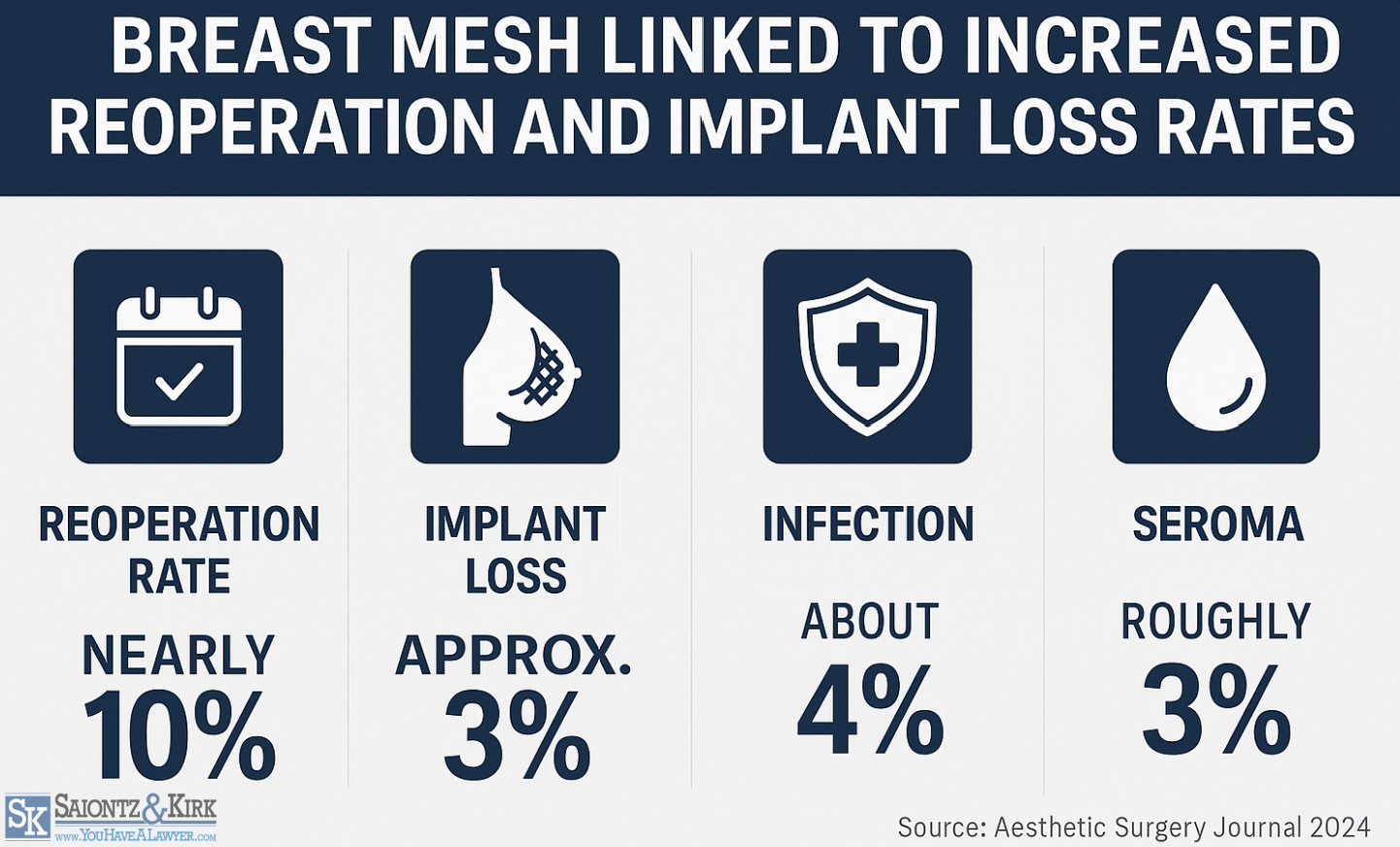
The study findings raise concerns among many patients and health care providers about the risk that synthetic mesh may be associated with postoperative complications, even though long-term safety outcomes were not addressed by researchers.
Breast Mesh Infection and Seroma Formation Rates
Another 2023 meta-analysis published in the Aesthetic Surgery Journal examined 24 studies covering more than 2,000 breast reconstructions using biosynthetic mesh.
The authors reported measurable rates of mesh-related complications, including:
- Infection in approximately 5% of cases
- Seroma (fluid buildup) in about 5% of patients
- Skin necrosis in 5.5%, and implant loss in nearly 4%
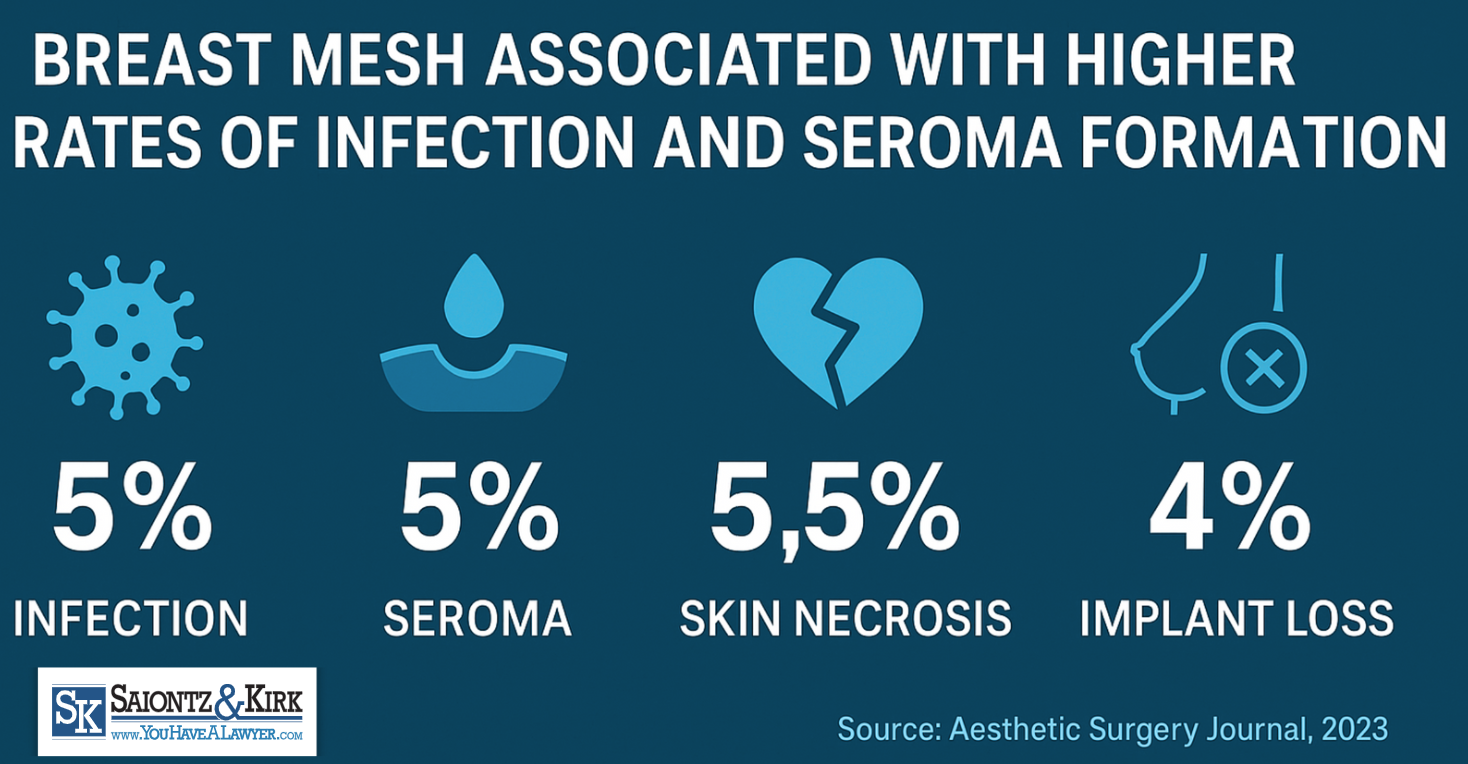
The studies reported measurable rates of infection, reoperation, and explant in patients receiving resorbable mesh in breast reconstruction
Manufacturers Should Have Known About Breast Mesh Failure Risks
The growing concerns over breast mesh implants follow a long history of similar problems involving surgical mesh products made by many of the same companies now under investigation.
For decades, manufacturers such as C.R. Bard, Ethicon, and Atrium have faced transvaginal mesh lawsuits and hernia mesh lawsuits over similar products that caused infection, erosion, and tissue damage. Despite billions paid in settlements and years of public safety warnings, these same companies sold many similar mesh products, which were widely used in the breast—again without adequate testing or FDA approval.
Transvaginal Mesh Failures
Transvaginal mesh was marketed as a minimally invasive way to treat pelvic organ prolapse (POP) and stress urinary incontinence (SUI). Manufacturers claimed it would restore pelvic support and improve women’s quality of life.
Instead, thousands of women experienced vaginal erosion, chronic pelvic pain, organ perforation, and nerve injuries when the mesh hardened or cut into surrounding tissue. After multiple FDA safety warnings and a 2016 reclassification that required new premarket approval, all major transvaginal mesh products were withdrawn from the market.
More than 100,000 vaginal mesh lawsuits were filed against manufacturers including Ethicon (Johnson & Johnson), C.R. Bard, and Boston Scientific, resulting in widespread recalls and billions of dollars in transvaginal mesh settlements and verdicts.
Hernia Mesh Failures
Hernia mesh devices, often made of polypropylene or absorbable polymers, were similarly promoted as durable, long-term repairs for abdominal wall defects. Over time, many of these products were linked to infection, adhesions, migration, and mesh shrinkage, particularly in high-moisture, high-movement areas of the body—conditions very similar to the breast environment.
Thousands of hernia mesh lawsuits have been filed against Bard, Ethicon, and Atrium, resulting in multidistrict litigations (MDLs) and substantial financial settlements.
Breast Mesh Draws Scrutiny Amid Similar Safety Concerns
Despite years of hernia mesh lawsuits and transvaginal mesh lawsuits over complications associated with similar surgical products, manufacturers continued to sell their mesh-based materials for use in breast reconstruction and augmentation procedures, without providing adequate warnings for women or the medical community.
Many of the mesh products that may soon be implicated in these internal bra lawsuits involve similar synthetic polymers or scaffold-based designs. Cosmetic surgeons and critics now question the safety of implanting surgical mesh products in breast tissue, which is an area subject to constant movement and a heightened risk of infection.
The parallels are unmistakable. Many of the same companies, using similar materials, are likely to once again face allegations of placing profits before patient safety, by failing to adequately research the side effects of breast mesh, or warn about serious complications women may experience, including:
- Infection and abscess formation
- Tissue erosion and necrosis
- Chronic pain and nerve injury
- Mesh detachment and deformity
Allegations Raised in Breast Mesh Lawsuits
Breast mesh lawsuits raise allegations similar to those seen in prior medical device mass torts involving unsafe implantable materials, indicating that manufacturers of the internal bra products:
- Failed to warn doctors and patients about the risks of infection, scarring, and reconstruction failure.
- Misrepresented product safety, claiming that the mesh would integrate naturally into tissue or dissolve safely over time.
- Ignored mounting adverse event reports, including mesh degradation, detachment, and implant loss.
- Withheld or downplayed data showing early device failures in breast applications.
- Failed to conduct proper testing to determine how mesh materials perform inside delicate breast tissue before widespread marketing.
These allegations mirror those raised in prior mesh litigation, where companies were accused of putting profits before patient safety and continuing to sell devices despite known risks.
How Long Do I Have to File a Breast Mesh Lawsuit?
Every state has its own statute of limitations that governs how long an individual has to file a product liability lawsuit. In most jurisdictions, these deadlines range from one to three years after the date an injury was, or reasonably should have been, discovered.
Breast mesh complications often appear months or even years after surgery, which can make determining the applicable deadline more complex. The time to file a claim may depend on several factors, including:
- The date of the initial breast reconstruction, augmentation, or revision surgery
- When symptoms or complications related to the mesh were first diagnosed
- Whether the mesh has been surgically removed or replaced
- State-specific discovery rules governing medical device injuries
Women who believe their injuries may be related to breast mesh failure should consult an attorney as soon as possible to determine how the statute of limitations may apply to their circumstances and to ensure their right to pursue compensation is protected.
How Much Is a Breast Mesh Lawsuit Settlement Worth?
The value of a potential breast mesh lawsuit settlement will depend on the specific facts and circumstances of each individual case. Since the litigation remains in the early stages, no settlements or verdicts have yet been reached. However, the factors that typically influence compensation in medical device claims are well established.
In evaluating a breast mesh claim, attorneys consider:
- Nature and extent of the injuries: The severity of medical complications, such as infection, chronic pain, or tissue loss, plays a significant role in determining the potential value of a claim.
- Need for revision or removal surgery: Cases involving multiple surgeries, prolonged recovery, or permanent disfigurement generally support higher damages due to the increased physical and emotional toll.
- Duration and degree of pain and suffering: Ongoing pain, nerve damage, or loss of sensation may be considered when assessing non-economic damages.
- Impact on quality of life: Women who experience long-term physical limitations, emotional distress, or loss of confidence following reconstructive failure may be entitled to compensation for diminished quality of life.
- Medical expenses and financial losses: Past and future medical costs, as well as any lost wages or reduced earning capacity, are important components of a damages calculation.
- Evidence of negligence or misconduct: If it is shown that manufacturers promoted mesh products for unapproved uses or withheld safety information, punitive damages may be warranted to deter similar conduct in the future.
Each breast mesh lawsuit will be evaluated individually, and any settlement amount will depend on the strength of the evidence, the severity of the injuries, and the overall impact on the individual’s health and livelihood.
Are There Any Costs to Hire an Internal Bra Mesh Lawyer?
There are absolutely no out-of-pocket costs to review your case or hire our attorneys. Potential claims are evaluated for individuals throughout the United States, and all cases are handled on a contingency fee basis.
Through the use of contingency attorney fees, individuals have access to the experience and resources of our national law firm for their Breast Mesh lawsuit settlement — regardless of their individual financial resources.
You pay nothing up front to hire our lawyers, and we only receive an attorney fee or expenses out of the money that is obtained from the manufacturers. Our law firm receives nothing unless we win your case!
What are the steps in a Breast Mesh case evaluation?
Complete Our Case Evaluation Request Form. Providing contact information and some information about your Breast Mesh injury case.
Get Contacted by Saiontz & Kirk You will be contacted by our law firm to help determine if financial compensation may be available for you and your family.
You Decide If You Want to Move Forward. If our lawyers determine that we can help with your case then you decide whether to move forward and hire us to pursue compensation.
Real results. Real reviews.
Here’s what our clients have to say.
