

Chlorpyrifos Parkinson’s Disease Lawsuit for Gulf War Veterans
Chlorpyrifos Parkinson’s disease lawsuits allege that pesticide manufacturers have sold organophosphate insecticides for decades without adequately studying the potential risks associated with their products, or warning about the long-term side effects on the brain.
During Operations Desert Shield and Desert Storm, pesticides were widely used to protect military personnel from insects and disease in a region where large numbers of troops lived in temporary encampments, tents and crowded fixed facilities. Government reports indicate that pesticides were applied where service members worked, ate and slept, creating opportunities for Gulf War chlorpyrifos exposure even among veterans who did not personally mix or spray the chemicals.
Lawsuits claim that chlorpyrifos can contribute to inflammation, abnormal protein accumulation and the loss of dopamine-producing neurons associated with Parkinson’s disease. They further allege that manufacturers failed to provide adequate warnings that neurological damage could develop gradually and remain unnoticed until years after the exposure occurred.
Who Is the Chlorpyrifos Lawsuit Against?
These are product liability claims being pursued against the companies responsible for developing, manufacturing and selling chlorpyrifos pesticides. They are not lawsuits against the Department of Veterans Affairs, the Department of Defense or any branch of the military.
Chlorpyrifos manufacturers that face potential liability for Gulf War veteran Parkinson’s disease claims include:
- The Dow Chemical Company
- Corteva, Inc.
- Corteva Agriscience
- FMC Corporation
- Other pesticide manufacturers, formulators and sellers connected to the products involved
The specific companies responsible for a veteran’s claim will depend on the pesticide products that were available or used during the relevant deployment period.
Who May Qualify for a Gulf War Chlorpyrifos Lawsuit?
Gulf War veterans do not need to establish that a particular spray contained chlorpyrifos before contacting our lawyers. Deployment dates, locations, unit assignments, military occupation and government pesticide-use records may provide the basis for investigating the exposure.
Saiontz & Kirk is reviewing claims for veterans who:
- Were formally diagnosed with Parkinson’s disease
- Served during Operation Desert Shield or Operation Desert Storm
- Were deployed to the Persian Gulf region during the First Gulf War
- Lived or worked at a military location where pesticides were used for insect control
- Performed pest-control, preventive-medicine, sanitation, logistics or related duties
- Remember spraying, fogging, pest strips, fly bait or chemical treatments around military living or working areas
- Do not remember a specific pesticide but have qualifying deployment records
Contact our chlorpyrifos lawyers for a free consultation to determine if you may be eligible to pursue a claim for compensation. All cases are handled on a contingency fee basis, which means there are no fees or expenses unless we win your case.
Info About Gulf War Parkinson’s Lawsuits On This Page
Chlorpyrifos Use During the Persian Gulf War
Where Gulf War Veterans May Have Encountered Pesticides
What Military Records Say About Chlorpyrifos Use
Why Veterans May Not Remember the Pesticide Name
Which Veterans May Have Faced Greater Pesticide Exposure
Chlorpyrifos and Parkinson’s Disease
Parkinson’s Disease Symptoms Veterans and Families May Notice
Why a Diagnosis Decades After Deployment May Matter
Free Gulf War Registry Health Exam Through the VA
Is Parkinson’s Disease Presumptive for Gulf War Veterans?
Will a Chlorpyrifos Lawsuit Affect VA Benefits?
Evidence That May Support a Gulf War Veteran’s Claim
What Veterans and Their Families Can Do Now
Compensation for Gulf War Veterans With Parkinson’s Disease
Saiontz & Kirk — A Veteran’s Legal Resource
Contact a Gulf War Parkinson’s Disease Lawyer
Chlorpyrifos Use During the Persian Gulf War
After Iraq invaded Kuwait in August 1990, the United States deployed more than 650,000 service members to the region for Operations Desert Shield and Desert Storm. Large military populations were rapidly established throughout Saudi Arabia, Kuwait and neighboring countries, often in temporary and crowded environments where heat, food storage, waste and limited sanitation attracted significant insect activity.
Military pest-control programs were used to protect service members from mosquitoes, flies, sand flies, fleas, lice and other pests that could spread disease, contaminate food and interfere with sleeping and daily operations. Government reports identify regional concerns involving malaria, sand fly fever, typhus and leishmaniasis.
Chlorpyrifos and other organophosphate pesticides were used as part of these efforts. More than 60 pesticide products and formulations were reportedly used during the Gulf War, including sprays, powders, baits, pest strips and flypaper.
Service members were deployed throughout locations that included:
- Saudi Arabia
- Kuwait
- Iraq
- Bahrain
- Qatar
- Oman
- The United Arab Emirates
- The Persian Gulf and surrounding waters
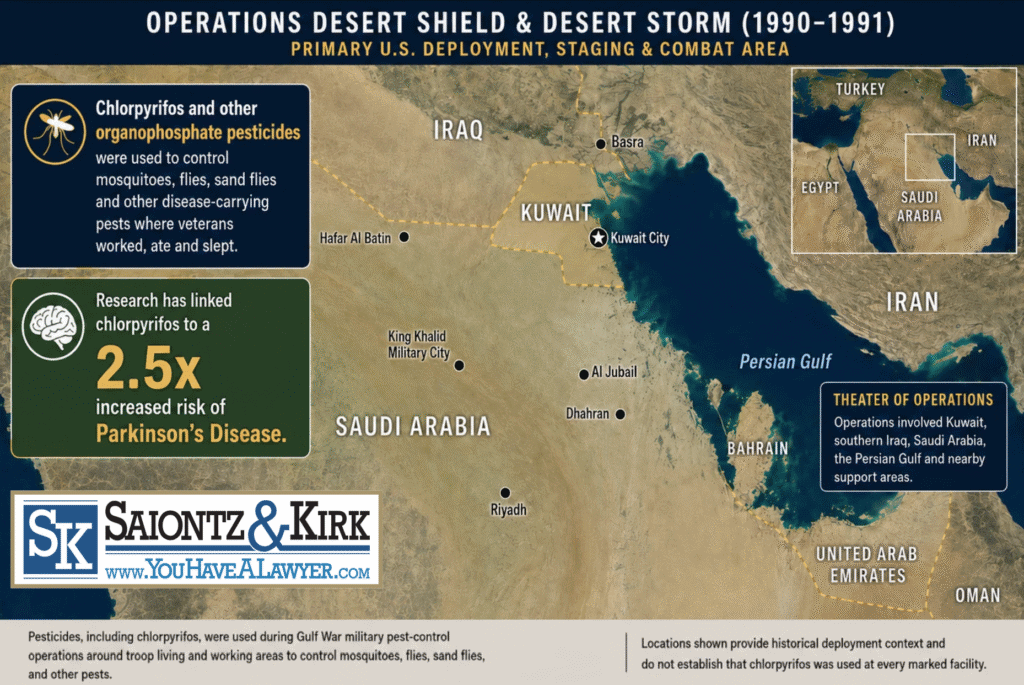
In addition to claims for individuals directly exposed to chlorpyrifos in the United States, this litigation includes claims for veterans who served during the First Gulf War period, even though the VA uses a broader definition of Gulf War service for certain health programs and benefits.
Where Gulf War Veterans May Have Encountered Pesticides
Many troops lived in tent cities, temporary camps, staging areas and forward operating positions rather than conventional permanent barracks. Others were assigned to airfields, ports, logistics compounds and established military facilities, where pest control was performed around sleeping quarters, food supplies, sanitation areas, vehicles and equipment.
Government records reference troop movements and assignments involving locations such as Dhahran, King Khalid Military City and Camp Doha. A veteran does not need to have served at one of those specific installations to request a claim review, since pesticide use occurred throughout the theater and complete application records were not consistently maintained. Potential exposure settings included:
- Tents and temporary troop quarters
- Fixed buildings, barracks and sleeping areas
- Kitchens and dining facilities
- Latrines, waste areas and sanitation sites
- Storage locations, vehicle yards and equipment areas
- Airfields, ports and logistics compounds
- Enclosed spaces where pest strips or insecticides were used
- Areas near spraying, fogging or contractor pest-control operations
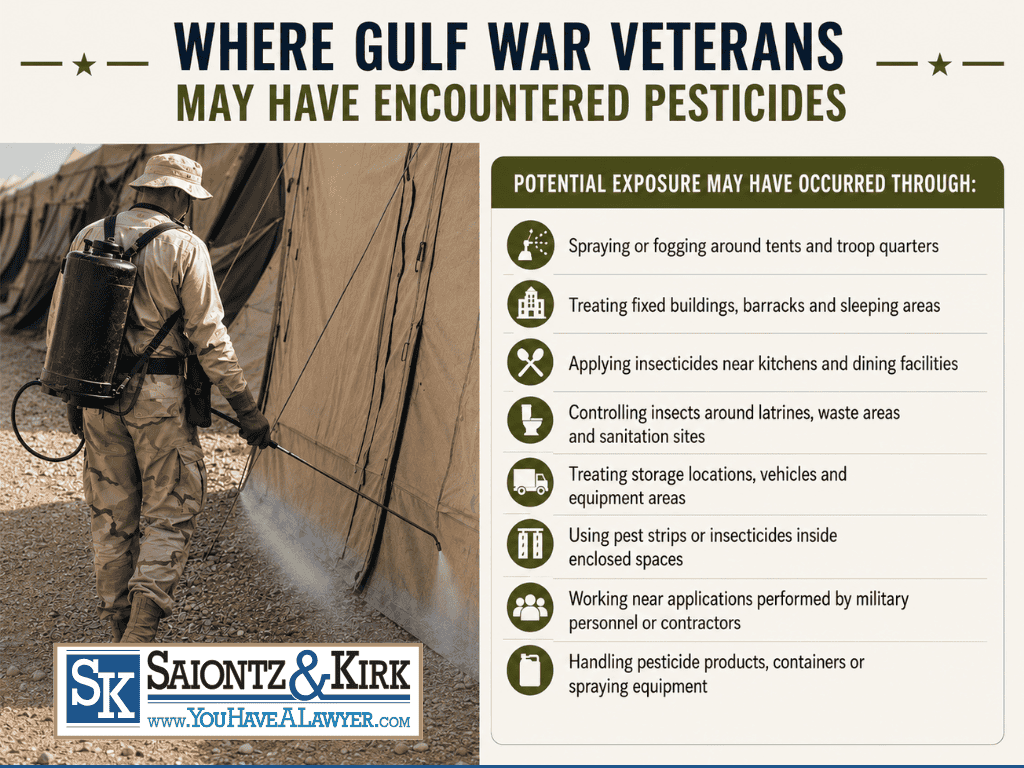
Some pesticides were also obtained through local sources, and civilian contractors performed certain pest-control work. Those applications were not always reflected in military supply or treatment records.
What Military Records Say About Chlorpyrifos Use
Department of Defense records specifically identify chlorpyrifos, including Dursban insecticide supplied in one- and five-gallon containers, among the pesticides shipped for use during the Gulf War. The government classified chlorpyrifos as an organophosphate pesticide.
Military reviews also identify azamethiphos, diazinon, dichlorvos and malathion among the other organophosphate pesticides used during deployment. These chemicals interfere with acetylcholinesterase, an enzyme needed for normal communication between nerves and muscles.
The available records do not establish that every Gulf War veteran encountered chlorpyrifos. However, they confirm that the pesticide was present in the theater and formed part of the broader military pest-control program. The Department of Defense did not maintain complete records showing:
- Where every pesticide shipment was sent
- Which units received particular products
- When and where each application occurred
- How frequently camps or facilities were treated
- Whether locally purchased products were substituted
- Which service members were present during treatment
- How much pesticide an individual inhaled or absorbed
As a result, an exposure investigation may rely on deployment locations, unit assignments, military occupations, living conditions and historical records describing pest-control practices at similar facilities.
Why Veterans May Not Remember the Pesticide Name
A veteran may remember the smell of spraying, fog moving through a camp, pest strips hanging inside a tent or insects being treated near sleeping and dining areas without ever knowing the chemical involved.
Most service members were not responsible for selecting pesticides, reading product labels or documenting applications unless those tasks were part of their assigned duties. They may not know whether the product came from military inventory, a local supplier or a civilian contractor.
A veteran does not need to identify chlorpyrifos by name before requesting a claim review. Deployment records, unit assignments, occupational duties, statements from fellow service members and historical pesticide reports may help determine whether the circumstances support further investigation.
Which Veterans May Have Faced Greater Pesticide Exposure
Pesticide exposure was not limited to certified applicators. However, veterans whose duties involved selecting, storing, mixing, applying or maintaining pesticide equipment may have experienced more direct or repeated contact.
Potentially higher-exposure groups include:
- Preventive-medicine personnel
- Military pest-management specialists
- Medical entomologists
- Environmental-health technicians
- Field-sanitation team members
- Air Force civil-engineering pest controllers
- Military police assigned to delousing or pest-control duties
- Supply and logistics personnel who stored or transported pesticides
- Personnel who mixed, sprayed or fogged insecticides
- Service members who handled pesticide containers or concentrates
- Personnel who cleaned, repaired or maintained application equipment
Government investigators estimated that approximately 3,500 to 4,500 individuals performed pesticide-application work during the Gulf War. This included trained applicators, field-sanitation teams and military police involved in delousing operations.
Veterans who were not trained applicators may still qualify for a claim review when their service records and deployment conditions indicate repeated proximity to military pest-control activities.
Chlorpyrifos and Parkinson’s Disease
Parkinson’s disease is a progressive neurological disorder that develops as dopamine-producing neurons in the brain become damaged and die. Dopamine helps regulate movement, coordination and balance.
Recent research has linked long-term chlorpyrifos exposure to more than a 2.5-fold increased risk of developing Parkinson’s disease. Experimental findings have also associated the pesticide with movement problems, brain inflammation, abnormal alpha-synuclein accumulation and the loss of dopamine-producing neurons.
Chlorpyrifos exposure may contribute to neurological damage through several processes, including:
- Oxidative stress
- Mitochondrial dysfunction
- Brain inflammation
- Disruption of dopamine pathways
- Impaired removal of damaged proteins
- Alpha-synuclein accumulation
- Loss of dopamine-producing brain cells
The research does not mean that every person exposed to chlorpyrifos will develop Parkinson’s disease. Lawsuits allege that manufacturers should have adequately studied these risks and warned that neurological damage could develop gradually and remain unnoticed for years.
Parkinson’s Disease Symptoms Veterans and Families May Notice
Parkinson’s disease often begins gradually. Early changes may be mistaken for aging, an old injury or another health problem. Veterans and their families may notice:
- Tremors while the hand or another part of the body is resting
- Slowed movement
- Muscle stiffness
- Shuffling steps
- Freezing or difficulty beginning to walk
- Balance problems or repeated falls
- Reduced arm movement while walking
- Quiet, soft or slurred speech
- Smaller handwriting
- Reduced facial expression
- Difficulty swallowing
- Loss of smell
- Sleep disturbances
- Depression or mood changes
- Memory problems or cognitive decline

Saiontz & Kirk is reviewing claims for veterans with a formal Parkinson’s disease diagnosis. Symptoms alone do not establish eligibility, but veterans experiencing these changes should speak with a physician or neurologist.
Why a Diagnosis Decades After Deployment May Matter
Operations Desert Shield and Desert Storm occurred more than 35 years ago. Veterans who deployed as young adults are now reaching the ages when Parkinson’s disease is more commonly diagnosed.
The disease may progress for years before recognizable movement problems develop. Tremors, stiffness, slowed movement and balance difficulties may not appear until significant neurological damage has already occurred.
A long period between deployment and diagnosis does not necessarily mean the exposure history is irrelevant. It is one reason government and medical researchers have emphasized continued monitoring of aging Gulf War veterans.
National Academies Recommends Continued Monitoring
The National Academies has not concluded that Gulf War deployment or chlorpyrifos exposure caused Parkinson’s disease among veterans.
However, its 2016 Gulf War health review recommended that the VA continue conducting follow-up assessments for neurodegenerative diseases that have long latency periods and are associated with aging. The recommendation specifically included Parkinson’s disease, Alzheimer’s disease and ALS.
The National Academies explained that the Gulf War veteran population had previously been relatively young for these disorders, meaning any deployment-related pattern may not have been apparent in earlier research.
The recommendation does not establish that an individual veteran has a chlorpyrifos claim. It does recognize the importance of continuing to study Parkinson’s disease as Gulf War veterans grow older.
Free Gulf War Registry Health Exam Through the VA
The Department of Veterans Affairs offers eligible veterans a free Gulf War Registry Health Exam to identify possible long-term health problems related to military service. The exam includes:
- A review of military and environmental exposure history
- A medical history
- A physical examination
- Laboratory testing when appropriate
- A discussion of the findings with a VA health professional
- A follow-up letter summarizing the examination
There is no copayment, and veterans do not need to be enrolled in the VA health care system to participate. Eligibility is based on the veteran’s recollection of qualifying service rather than submission of military records.
Veterans may request the exam by contacting a VA Environmental Health Coordinator. The VA maintains a state-by-state directory of coordinators who can assist with scheduling. Eligible locations include:
- Bahrain
- Iraq
- Kuwait
- Oman
- Qatar
- Saudi Arabia
- The United Arab Emirates
- The Arabian Sea
- The Gulf of Aden
- The Gulf of Oman
- The Persian Gulf
- The Red Sea
- The airspace above those locations
The VA currently defines registry eligibility as service in those areas on or after August 2, 1990.
Is Parkinson’s Disease Presumptive for Gulf War Veterans?
Parkinson’s disease is not automatically presumed to have resulted from Gulf War pesticide exposure merely because a veteran served in Southwest Asia.
The VA recognizes certain medically unexplained chronic illnesses and infectious diseases as presumptively related to qualifying Gulf War service. Parkinson’s disease is not currently listed among those Gulf War presumptive conditions.
This does not prevent a veteran from seeking VA benefits. A non-presumptive condition may still be claimed through evidence establishing an individual connection to military service.
A VA disability claim and a chlorpyrifos lawsuit are separate matters. They involve different defendants, evidence and legal standards.
Will a Chlorpyrifos Lawsuit Affect VA Benefits?
A chlorpyrifos product liability lawsuit would be brought against pesticide manufacturers and sellers. It would not be a lawsuit against:
- The Department of Veterans Affairs
- The Department of Defense
- The Army, Navy, Air Force, Marine Corps or Coast Guard
- An individual commander or service member
Investigating a lawsuit does not mean the veteran must give up VA medical care or abandon a disability claim. Veterans may pursue the benefits and legal remedies available to them, subject to the specific rules governing each program.
Any effect that a recovery may have on other benefits or reimbursement rights would depend on the type of benefits received and the circumstances of the individual case.
Evidence That May Support a Gulf War Veteran’s Claim
Military pesticide exposure from more than three decades ago will rarely be proven by a single document. A claim may instead be developed by combining records that establish where the veteran served, what duties were performed and what pesticide activities occurred in that environment.
Helpful records may include:
- DD Form 214
- Deployment orders and dates
- Countries, camps, bases and installations
- Unit and command assignments
- Military occupational specialty
- Temporary-duty orders
- Preventive-medicine or field-sanitation duties
- Personnel evaluations
- Unit histories and operational reports
- Supply or pest-management records
- Photographs, letters or deployment journals
- Statements from fellow service members
- Gulf War Registry Health Exam records
- VA and private medical records
- Neurology records confirming Parkinson’s disease
- Records showing when symptoms began
- Records documenting treatment and disease progression
- Records showing disability and caregiving needs
A spouse, adult child or caregiver may contact Saiontz & Kirk and help gather records when Parkinson’s disease makes it difficult for the veteran to manage paperwork or describe events from deployment.
What Veterans and Their Families Can Do Now
Veterans and family members can begin gathering information even when they do not know the name of the pesticide involved. Useful first steps include:
- Confirming the Parkinson’s disease diagnosis
- Requesting neurology and treatment records
- Locating the veteran’s DD Form 214
- Writing down deployment dates and locations
- Identifying the veteran’s unit and military occupation
- Listing bases, camps and temporary locations where the veteran lived or worked
- Recording memories of spraying, fogging, pest strips or chemical smells
- Contacting former service members who remember the same conditions
- Requesting military personnel and service treatment records
- Considering a free VA Gulf War Registry Health Exam
- Contacting a lawyer before applicable filing deadlines expire
A veteran does not need to complete all of these steps before requesting a free consultation. The information already available may be enough to begin evaluating the claim.
Chlorpyrifos Lawsuit Allegations
The lawsuits focus on what pesticide manufacturers knew or should have known about the long-term neurological risks associated with chlorpyrifos, and whether they gave adequate warnings before the chemical was used in military and other settings.
Chlorpyrifos Parkinson’s disease lawsuits allege that pesticide manufacturers:
- Failed to adequately study the long-term neurological effects
- Failed to investigate the risk of Parkinson’s disease
- Sold an unreasonably dangerous pesticide
- Failed to warn about permanent neurological damage
- Minimized or concealed evidence of neurotoxicity
- Marketed chlorpyrifos as safe for foreseeable uses
- Relied on inadequate or misleading safety studies
- Failed to disclose relevant health information
- Continued selling chlorpyrifos without adequate Parkinson’s disease warnings
The claims seek to hold manufacturers and sellers responsible for the harm allegedly caused by their pesticide products. The lawsuits are not claims against the military or federal government.
Compensation for Gulf War Veterans With Parkinson’s Disease
A chlorpyrifos lawsuit may seek compensation for the medical, financial and personal effects of Parkinson’s disease, including:
- Past and future medical care
- Prescription medications
- Neurological treatment
- Physical, occupational and speech therapy
- Lost income
- Reduced earning capacity
- Permanent disability
- Pain and suffering
- Loss of independence
- Mobility aids
- Home modifications
- In-home assistance
- Full-time caregiving
- Loss of companionship and support for a spouse
- Funeral expenses and wrongful death damages when applicable
The amount of compensation available will depend on the veteran’s exposure history, medical evidence, age at diagnosis, disease progression and the effect Parkinson’s disease has had on the veteran and family.
Saiontz & Kirk — A Veteran’s Legal Resource
Saiontz & Kirk has served as a legal resource for veterans and military families facing injuries linked to defective products, toxic exposures and unsafe conditions connected to their service. Our lawyers have helped investigate and pursue claims involving 3M Combat Arms military earplugs, which were issued to service members who later developed hearing loss or tinnitus, as well as Camp Lejeune water contamination claims for veterans and families exposed to toxic chemicals at the Marine Corps base.
Our firm also represents individuals pursuing lawsuits over AFFF firefighting foam and PFAS contamination, including cases for military personnel exposed while using firefighting foam or drinking contaminated water near military installations.
For more than 50 years, Saiontz & Kirk has represented individuals harmed by corporations, dangerous products and environmental contamination. Veterans diagnosed with Parkinson’s disease after Gulf War pesticide exposure can speak with our lawyers about their service history, medical diagnosis and potential right to compensation without paying any upfront legal fees or expenses.
Contact a Gulf War Parkinson’s Disease Lawyer
Saiontz & Kirk is reviewing chlorpyrifos claims for Gulf War veterans diagnosed with Parkinson’s disease after serving during Operations Desert Shield or Desert Storm.
Our lawyers will review the veteran’s deployment history, unit assignment, military duties, living conditions, potential pesticide exposure and medical records. It is not necessary to remember the name of a specific insecticide before requesting a free claim review.
There are no upfront legal fees or expenses. Claims are handled on a contingency fee basis, which means Saiontz & Kirk receives no attorney fee or reimbursement of expenses unless compensation is obtained.
Call 1-800-522-0102 or complete the free claim-review form to speak with a Gulf War chlorpyrifos lawyer.
FIND OUT IF YOU QUALIFY FOR A CHLORPYRIFOS LAWSUIT SETTLEMENT