
Olympus Scope Infection Problems Highlighted By Years of FDA Warnings Over Reusable Scope Risks

The product liability lawyers at Saiontz & Kirk are investigating Olympus scope infection lawsuits for individuals who developed serious infections after colonoscopy, endoscopy and ERCP procedures, where reusable endoscopic devices became contaminated with bacteria, tissue or other biological material from prior patients.
The lawsuits involve allegations that Olympus designed and sold unreasonably dangerous scopes, which contain design defects that make them nearly impossible to properly clean, disinfect or sterilize between procedures.
While many individuals contacting our law firm are just now learning about the Olympus scope infection problems, in this post we will outline the long history of FDA warnings, recalls and hospital infection outbreak reports that have been reported, highlighting the serious risks associated with these devices.
Request a Free Claim Review by a SCOPE INFECTION LAWYER

⚖️ Olympus Scope Infection Lawsuits
Despite these repeated warnings and safety issues, Olympus has failed to fix the known design and manufacturing problems that allowed bacteria, tissue or biological material to survive the recommended cleaning and reprocessing steps outlined when these devices were distributed to hospitals and medical clinics.
As a result, our scope infection lawyers are pursuing financial compensation for individuals who have been left with devastating infections and complications, such as:
- Sepsis
- Bloodstream infections
- Carbapenem-resistant Enterobacteriaceae (CRE)
- E. coli infections
- Exposure to blood-borne infections, including HIV or tuberculosis
- Wrongful death
If you or a loved one experienced problems, find out if you qualify for a colonoscopy infection lawsuit, endoscopy infection lawsuit or ERCP infection lawsuits by calling our law firm toll free at 1-800-522-0102, or completing the form on this page.
All cases are reviewed by our scope infection lawyers on a contingency fee basis, which means that there are no fees or expenses charged unless a settlement or recovery is obtained.
More Info in this Post About Olympus Scope Infection Problems
Timeline of FDA Actions Involving Reusable Scope Infection Risks
Manufacturer Responsibility for Reusable Medical Device Reprocessing
How FDA Warnings Support Olympus Scope Lawsuit Investigations
Olympus Scope Infection Lawsuit Investigation
Timeline of FDA Actions Involving Reusable Scope Infection Risks
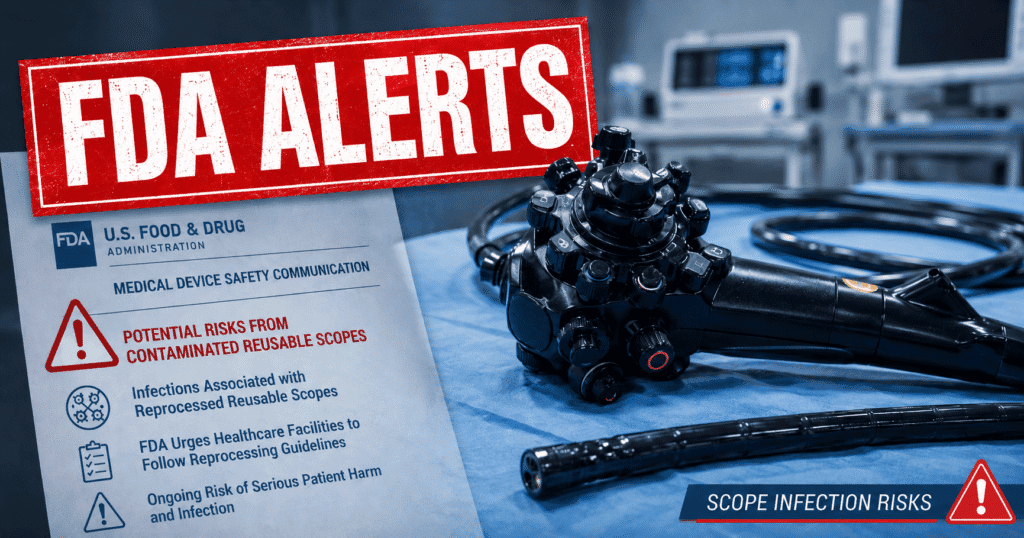
Medical scopes have been the focus of repeated FDA warnings, enforcement actions and infection concerns over the past decade, as federal regulators have examined whether reusable endoscopes, duodenoscopes, bronchoscopes and urological scopes can be reliably cleaned between patients.
Below, we will outline a series of FDA actions involving reusable scope infection risks, including warnings about difficult-to-clean devices, manufacturer reporting failures, postmarket study requirements and quality control concerns.
2015: FDA Warns Duodenoscope Design May Impede Effective Cleaning
In February 2015, the FDA issued a Safety Communication warning that the complex design of ERCP endoscopes, also called duodenoscopes, may make them difficult to effectively reprocess. The agency raised concerns that the devices contain small moving parts and hard-to-clean areas where tissue, fluid or bacteria may remain after cleaning.
Key concerns raised by the FDA included:
- The complex design of duodenoscopes may make effective cleaning difficult
- Small moving parts may be hard to access during reprocessing
- Tissue, fluid or bacteria may remain after cleaning
- Contamination may spread from one patient to another during later procedures
- Infections may occur even when facilities follow manufacturer reprocessing instructions
2015: FDA Advisory Panel Reviews Reprocessing and Device Design Concerns
In May 2015, the FDA convened the Gastroenterology-Urology Devices Panel of the Medical Devices Advisory Committee to examine duodenoscope reprocessing concerns. The panel discussed whether additional steps were needed to reduce the risk of infection transmission from reusable scopes.
The advisory panel focused on several major issues:
- Manual cleaning and staff training
- Human factors testing for reprocessing instructions
- Device design features that may affect cleaning
- Microbiological culturing after reprocessing
- Supplemental measures such as sterilization or repeat high-level disinfection
- The potential use of disposable parts or device disassembly to improve cleaning
2015: FDA Orders Olympus, Fujifilm and Pentax to Conduct Postmarket Surveillance Studies
In October 2015, the FDA ordered Olympus, Fujifilm and Pentax to conduct postmarket surveillance studies, known as 522 studies, to better understand how duodenoscopes were being reprocessed in real-world settings and determine the resulting contamination rates.
The required studies were intended to examine whether duodenoscopes remained contaminated after reprocessing, whether manufacturer cleaning instructions were adequate in practice, and whether additional safety measures were needed to protect patients.
This action is critical because it shows the FDA required the three major U.S. duodenoscope manufacturers to study whether their devices could be cleaned safely after use on patients, which may support claims that manufacturers had an obligation to investigate and address contamination risks.
2018: FDA Issues Warning Letters to Olympus, Fujifilm and Pentax Over Postmarket Study Failures
In March 2018, the FDA issued Warning Letters to Olympus, Fujifilm and Pentax for failing to provide sufficient data to satisfy required postmarket surveillance study obligations. These studies had been ordered to assess whether duodenoscopes could be effectively reprocessed and reused without contamination.
The FDA warning letters involved all three duodenoscope manufacturers with products sold in the United States:
- Olympus Medical Systems Corporation
- Fujifilm Medical Systems USA
- Pentax of America
For Olympus scope infection lawsuits, this action is significant because it shows that regulators believed manufacturers had not provided enough data to evaluate real-world reprocessing and contamination risks.
2018: FDA Reports Higher Than Expected Contamination Rates After Reprocessing
In December 2018, the FDA issued a Safety Communication providing interim results from the mandated postmarket surveillance studies. The FDA reported higher than expected contamination rates after duodenoscope reprocessing, raising concerns that bacteria or biological material could remain on the devices even after cleaning.
2018 Olympus $85 Million Settlement Over Duodenoscope Infection Reporting Failures
In 2018, Olympus Medical Systems Corporation agreed to pay $85 million after pleading guilty to federal charges involving its failure to file FDA-required adverse event reports about serious infections linked to duodenoscopes.
According to the Department of Justice, Olympus and a former senior executive admitted that the company continued selling the devices in the United States despite failing to provide regulators with required infection-related reports. Department of Justice Olympus Guilty Plea Announcement
The penalties included $80 million in criminal fines and $5 million in criminal forfeiture.
2019: FDA Recommends Transition to Duodenoscopes With Innovative Designs
In August 2019, the FDA issued a Safety Communication recommending that hospitals and endoscopy facilities begin transitioning to duodenoscopes with innovative designs that facilitate or eliminate the need for reprocessing. The FDA also noted that Fujifilm, Pentax and Olympus were withdrawing fixed endcap duodenoscopes from the market.
2022: Aizu Olympus Warning Letter Over Endoscopes and Reprocessors
In November 2022, the FDA issued a warning letter to Aizu Olympus Co., Ltd., after inspecting a facility in Japan that manufactured sterile and non-sterile endoscopes, as well as automated endoscope reprocessors.
The FDA cited concerns involving federal quality system requirements, stating that the company’s manufacturing methods, facilities or controls did not conform to required standards involving:
- Sterile endoscopes
- Non-sterile endoscopes
- Automated endoscope reprocessors
- Manufacturing controls
- Quality system requirements
Automated endoscope reprocessors are used to help clean and disinfect scopes between patients. As a result, concerns involving both endoscopes and reprocessing equipment may become relevant in cases alleging that contaminated scopes were not reliably sterilized before reuse.
Manufacturer Responsibility for Reusable Medical Device Reprocessing
The FDA has issued guidance for manufacturers of reusable medical devices, emphasizing that companies are responsible for providing cleaning, disinfection and sterilization instructions that are validated and reliable.
This is an important issue in Olympus scope lawsuits because manufacturers cannot simply rely on hospitals to clean a device if the device’s design makes complete cleaning unreliable.
Reusable device manufacturers are expected to address several key questions:
- Can the device be fully cleaned after use?
- Can users reach all areas where biological material may collect?
- Are cleaning instructions scientifically validated?
- Are reprocessing instructions clear and practical for healthcare facilities?
- Do warnings adequately explain infection risks?
- Should the device be redesigned with disposable parts or single-use components?
If a reusable scope cannot be reliably cleaned under ordinary medical conditions, lawsuits may argue that the device was defectively designed or sold with inadequate instructions or warnings.
How FDA Warnings Support Olympus Scope Lawsuit Investigations
The FDA warnings, warning letters and federal enforcement actions may play an important role in Olympus scope lawsuits, particularly claims alleging that infections were caused by defects in the design, manufacture, warnings or reprocessing instructions provided with reusable medical scopes.
Unlike traditional medical malpractice claims, which focus on whether a doctor or hospital made a mistake, Olympus scope lawsuits may focus on whether the device itself was unsafe for repeated use. Plaintiffs may argue that Olympus and other manufacturers knew or should have known that certain scopes could retain bacteria after cleaning, yet failed to redesign the devices, issue adequate warnings or provide reprocessing instructions that eliminated the risk.
Common product liability allegations may include:
- Defective design
- Manufacturing defects
- Failure to warn
- Inadequate reprocessing instructions
- Failure to report adverse events
- Continued sale despite known contamination risks
These claims may apply even when a patient has no reason to believe the doctor performed the procedure incorrectly. If the scope itself allowed contamination to remain after cleaning, the infection risk may have existed before the procedure began.
Olympus Scope Infection Lawsuit Investigation
The Olympus scope infection lawyers at Saiontz & Kirk are reviewing cases nationwide for individuals who developed serious infections after colonoscopy, endoscopy, ERCP, bronchoscopy or similar procedures.
You or a loved one may be eligible for an Olympus scope infection lawsuit if you underwent a procedure involving a contaminated reusable scope and developed:
- Sepsis
- Bloodstream infection
- CRE infection
- E. coli infection
- Pneumonia
- Urinary tract infection
- Organ failure
- Exposure to a blood-borne infection
- Other serious infection or injury
- Wrongful death
Call 1-800-522-0102 or request a free case evaluation today. There are no upfront costs, and no attorney fees unless compensation is recovered.
No Comments • Add Your Comments