

Products Linked to Parkinson’s Disease Lawsuits
Parkinson’s disease lawsuits are now being actively pursued by individuals who allege that years of exposure to certain pesticides caused permanent neurological damage and contributed to the progressive loss of dopamine-producing brain cells.
The claims focus on products that were widely used in agricultural, residential, commercial and military settings, often without warnings that Parkinson’s disease symptoms could develop years or even decades after the exposure ended.
- Chlorpyrifos Parkinson’s Disease Lawsuits: Individual claims are being filed by farmers, pest-control workers, residents, veterans and others who allege that exposure to chlorpyrifos products such as Lorsban and Dursban caused neurological damage linked to Parkinson’s disease.
- Paraquat Parkinson’s Disease Lawsuits: Claims are being actively pursued by farmers, agricultural workers and pesticide applicators who allege that repeated exposure to the restricted-use herbicide increased their risk of Parkinson’s disease. Thousands of lawsuits have been filed, including federal claims consolidated in a multidistrict litigation.
Although Paraquat was primarily used to kill weeds and chlorpyrifos was used to control insects, lawsuits involving both chemicals allege that manufacturers failed to adequately study the long-term risks, failed to warn users and continued selling products capable of causing permanent neurological harm.
Parkinson’s Disease Lawsuit Info On This Page:
Chlorpyrifos Parkinson’s Disease Lawsuits
Paraquat Parkinson’s Lawsuits
How Products May Contribute to Parkinson’s Disease
Parkinson’s Disease Claims May Involve Older Exposures
Parkinson’s Disease Injuries, Progression and Disability Claims
Parkinson’s Disease Treatment Costs
Parkinson’s Disease Diagnosis and Lawsuit Evidence
Parkinson’s Disease Lawsuit Allegations
Parkinson’s Disease Lawsuit Compensation
Deadline to File a Parkinson’s Disease Lawsuit
Contact a Parkinson’s Disease Lawyer
Chlorpyrifos Parkinson’s Disease Lawsuits
Chlorpyrifos is an organophosphate insecticide that was widely used on agricultural crops and around residential, commercial, industrial and military properties. It was sold under product names that include Lorsban, Dursban, Cobalt, NuFos, Bolton, Stallion, Lock-On and Warhawk.
Lorsban was commonly used in agriculture, while Dursban was widely applied for termites, roaches, ants and other pests before most residential uses were eliminated around 2000.
Chlorpyrifos was also used for insect control in certain military settings, including around camps, sleeping quarters, dining areas, equipment and other facilities during Operations Desert Shield and Desert Storm. Gulf War veterans may have experienced repeated exposure through pesticide applications intended to control flies, mosquitoes, roaches and other pests near living and working areas.
However, recent research linking long-term chlorpyrifos exposure to an increased risk of Parkinson’s disease has added support to individual lawsuits alleging that manufacturers failed to adequately study or warn farmers, pest-control workers, residents, veterans and other users about the potential neurological risks.
Chlorpyrifos Linked to 2.5x Risk of Parkinson’s
A 2025 study published in Molecular Neurodegeneration examined chlorpyrifos exposure among 829 individuals with Parkinson’s disease and 824 people without the condition. Researchers found that individuals with the longest-term residential exposure to chlorpyrifos had more than 2.5 times the risk of developing Parkinson’s disease compared with those without the same exposure history.
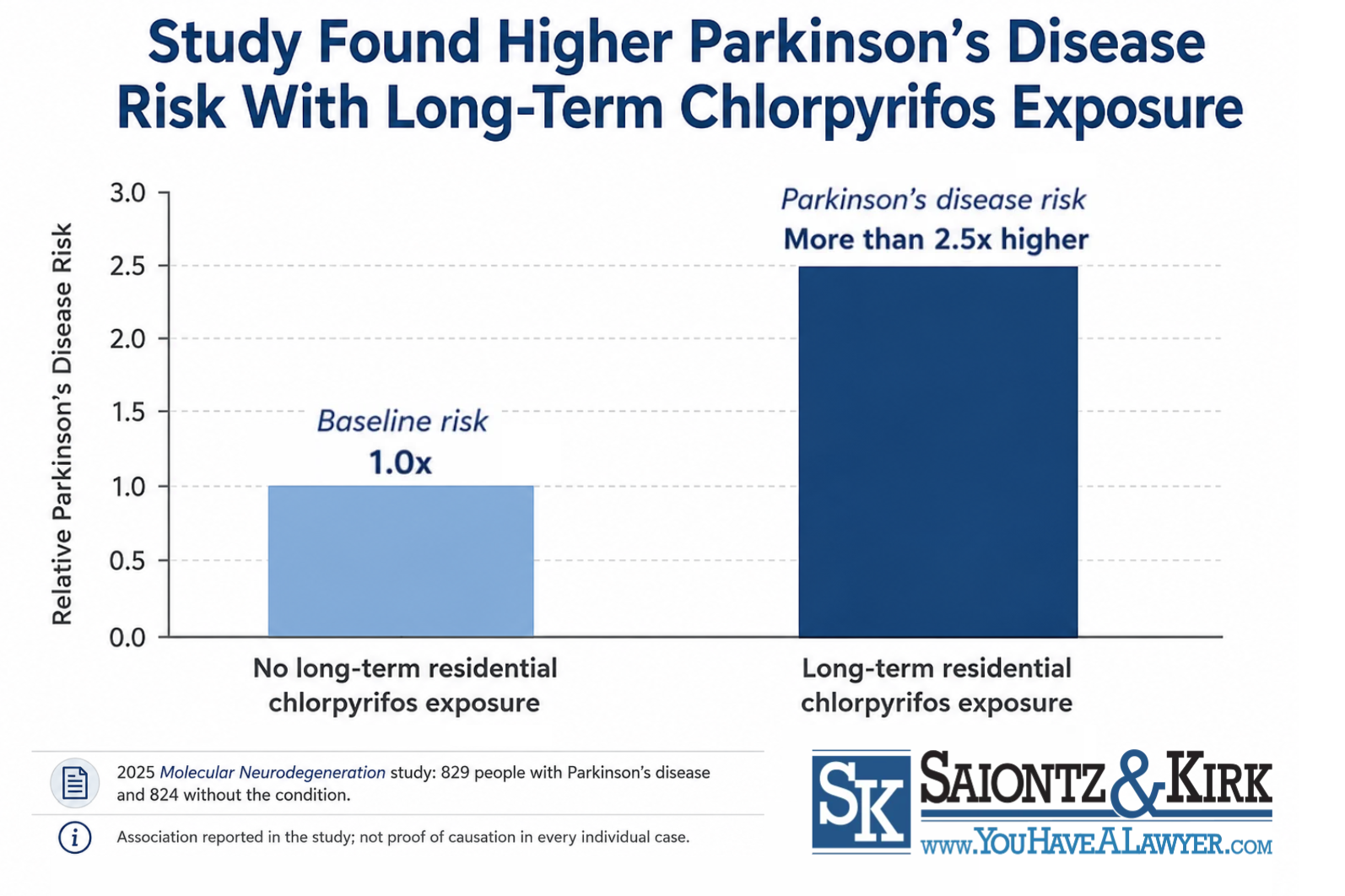
Researchers also tested chlorpyrifos in laboratory models to determine whether the pesticide could produce neurological changes associated with Parkinson’s disease. Exposed animals developed movement problems, loss of dopamine-producing neurons, brain inflammation and abnormal accumulation of alpha-synuclein, a protein associated with Parkinson’s disease.
The researchers concluded that the combined human and laboratory findings strongly implicated chlorpyrifos exposure as a Parkinson’s disease risk factor.
How to Identify Chlorpyrifos Exposure
Individuals diagnosed with Parkinson’s disease may remember treating crops, homes, commercial buildings or military facilities for insects without knowing that the product contained chlorpyrifos. Chlorpyrifos was generally used to:
- Kill agricultural insects
- Control termites
- Treat roaches, ants, flies and other pests
- Protect crops from insect damage
- Treat soil and building foundations
- Control pests around homes and commercial properties
- Control insects around military camps, sleeping quarters and other facilities
Details that may help identify chlorpyrifos exposure include:
- Use of Lorsban, Dursban or another chlorpyrifos product
- The name or appearance of the container
- Where the product was purchased or supplied
- The employer, farm, pest-control company or military unit involved
- The crop, building, camp or property being treated
- The insects being controlled
- The approximate years of use or military service
- The type of spraying or termite-treatment equipment involved
- Service during Operations Desert Shield or Desert Storm
- Exposure around Gulf War camps, sleeping areas, dining facilities, equipment or waste areas
- Statements from coworkers, fellow service members or family members
- Old photographs, invoices, service records, military records or pesticide logs
A chlorpyrifos claim may still be investigated even when the individual does not remember the product name. The type of pest treated, location of the application, military assignment and years when the exposure occurred may help identify whether chlorpyrifos was involved.
Who May Qualify for a Chlorpyrifos Lawsuit?
Saiontz & Kirk is reviewing chlorpyrifos claims involving:
- Mixing or applying Lorsban, Dursban or another chlorpyrifos product
- Farming and agricultural work
- Pest-control and termite-treatment work
- Repeated residential Dursban exposure
- Cleaning or repairing contaminated application equipment
- Agricultural spray drift or residue
- Golf-course, landscaping or groundskeeping work
- Repeated exposure inside treated buildings
- Qualifying military exposure involving chlorpyrifos insecticides
Because chlorpyrifos was used in agricultural, commercial and residential settings, a qualifying exposure history may look very different from a Paraquat claim.
FIND OUT IF YOU QUALIFY FOR A CHLORPYRIFOS LAWSUIT SETTLEMENT
Paraquat Parkinson’s Lawsuits
Paraquat is a restricted-use herbicide commonly applied in commercial agriculture to kill weeds, clear fields and control unwanted vegetation. It has been sold under product names that include Gramoxone, Firestorm, Helmquat, Parazone and Para-Shot.
However, the herbicide Paraquat has also been strongly linked to Parkinson’s disease in medical research.
As a result, thousands of Paraquat lawsuits have been filed by individuals alleging that repeated exposure contributed to their Parkinson’s disease. Federal claims have been consolidated in a multidistrict litigation in the U.S. District Court for the Southern District of Illinois. Additional lawsuits have also been pursued in state courts.
Paraquat lawsuits generally allege that manufacturers knew or should have known about potential neurological risks but failed to adequately warn farmers, applicators and agricultural workers.
Paraquat Linked to Risk of Parkinson’s
A 2011 study published in Environmental Health Perspectives examined pesticide use among farmers and licensed applicators enrolled in the Agricultural Health Study. Researchers found that individuals who reported using Paraquat had approximately 2.5 times the odds of developing Parkinson’s disease compared with participants who did not use the herbicide.
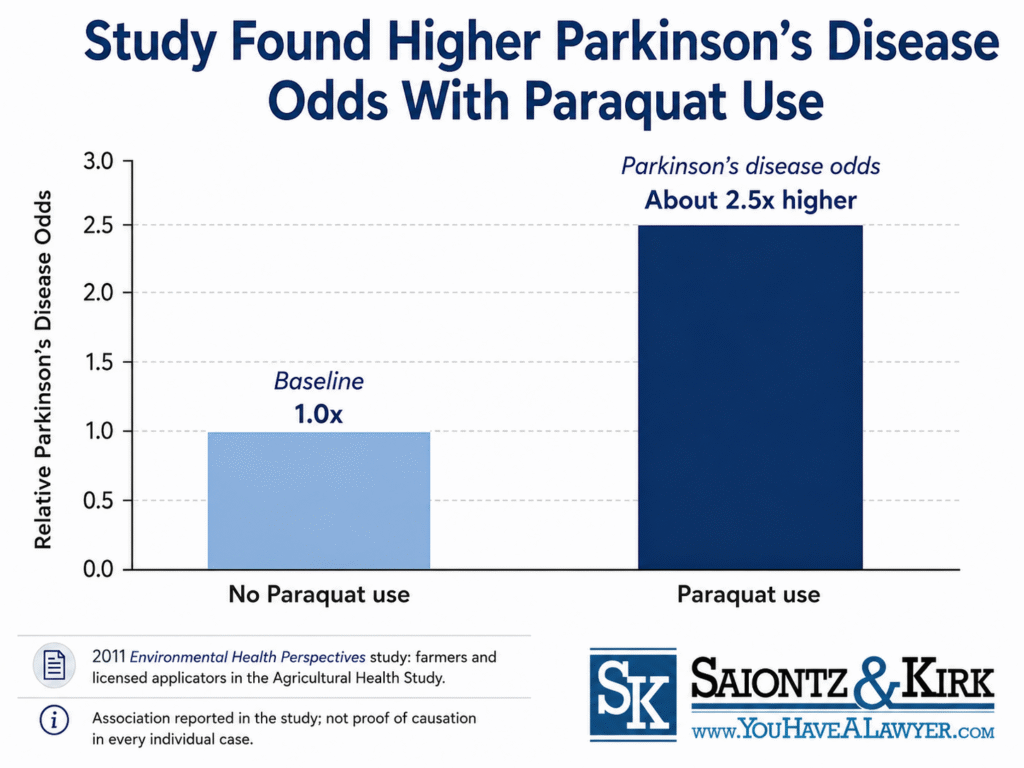
The findings added to concerns that repeated occupational Paraquat exposure may contribute to the neurological damage associated with Parkinson’s disease, although the study identified an association and did not establish that Paraquat caused every individual diagnosis.
How to Identify Paraquat Exposure
Many people diagnosed with Parkinson’s disease remember spraying fields or working around agricultural chemicals but do not remember the exact product name.Paraquat was generally used to:
- Kill weeds
- Clear fields and unwanted vegetation
- Prepare agricultural land for planting
- Control plant growth between crop rows
- Dry certain crops before harvest
Details that may help identify Paraquat exposure include:
- Use of Gramoxone or another Paraquat product
- The name, color or appearance of the container
- The farm or employer that supplied the chemical
- The crops being grown
- The approximate years of use
- The type of spraying equipment involved
- Whether the product required a licensed applicator
- Statements from coworkers or family members
- Old photographs, purchase records or pesticide application logs
A person should not assume that a Paraquat claim cannot be investigated simply because the exact product name has been forgotten. Employment records, crop histories and application practices may help determine whether Paraquat was used.
Who May Qualify for a Paraquat Lawsuit?
Saiontz & Kirk is reviewing Paraquat claims for individuals who:
- Were diagnosed with Parkinson’s disease or Parkinsonism
- Personally mixed or loaded Paraquat
- Applied Paraquat with handheld, backpack, tractor-mounted or truck-mounted equipment
- Worked as a farmer, agricultural employee or commercial pesticide applicator
- Cleaned or repaired equipment contaminated with Paraquat
- Worked around repeated Paraquat applications or spray drift
- Handled Paraquat containers or pesticide-covered clothing
- Used Gramoxone or another Paraquat product on multiple occasions
If you or a loved one were diagnosed with Parkinson’s or other neurological disorder after working with, or being routinely exposed to the herbicide Paraquat, contact our Paraquat lawsuit attorneys for a free consultation to see if you may be entitled to compensation.
FIND OUT IF YOU QUALIFY FOR A PARAQUAT LAWSUIT SETTLEMENT
How Products May Contribute to Parkinson’s Disease
Parkinson’s disease lawsuits allege that repeated exposure to certain pesticides can damage the neurological systems responsible for movement and contribute to the progressive loss of dopamine-producing cells.
Research involving Paraquat, chlorpyrifos and other environmental exposures has examined several forms of neurological damage, including:
- Oxidative stress
- Mitochondrial dysfunction
- Neuroinflammation
- Damage to dopamine-producing neurons
- Abnormal protein accumulation
- Disruption of normal nervous-system function
Dopamine allows different parts of the brain to communicate and helps control smooth, coordinated movement.
As dopamine-producing cells become damaged or die, individuals may begin experiencing tremors, muscle stiffness, slowed movement and balance problems.
Exposure to one pesticide does not mean someone will inevitably develop Parkinson’s disease. However, lawsuits allege that repeated or prolonged exposure can increase the risk, particularly when individuals mixed concentrated products, sprayed chemicals without adequate protection or regularly worked around treated areas.
Genetics and Environmental Exposure Claims
Parkinson’s disease lawsuits increasingly rely on research indicating that inherited genetics do not explain most diagnoses.
Scientists have identified certain genes that can cause Parkinson’s disease or make someone more susceptible to developing it. However, most people diagnosed with the condition do not have a clearly inherited form of the disease or a strong family history.
Current research generally views Parkinson’s disease as the possible result of several factors interacting over time, including:
- Aging
- Genetic susceptibility
- Environmental exposures
- Occupational chemical contact
Cellular stress and inflammation
A person may have an underlying genetic susceptibility that makes brain cells more vulnerable to chemical exposure. Another individual may develop Parkinson’s disease after substantial pesticide exposure despite having no known family history or identified genetic mutation.
These gene-environment interactions help explain why several people may experience similar exposures but not all develop the disease.
Why Parkinson’s Disease Claims May Involve Older Exposures
Parkinson’s disease may not be diagnosed until years or decades after the alleged harmful exposure occurred. A farmer, pesticide applicator or pest-control worker may have handled a chemical during the 1970s, 1980s, 1990s or early 2000s but not develop recognizable symptoms until much later.
The brain may compensate for the gradual loss of dopamine-producing cells for an extended period. Symptoms may not become obvious until the neurological damage has progressed far enough to interfere with movement and other functions.
Early signs may also be attributed to aging, arthritis, fatigue or an old injury. A person may initially notice:
- A mild tremor in one hand
- Smaller handwriting
- Reduced arm movement while walking
- Slower movement
- Muscle stiffness
- Difficulty standing from a chair
- A quieter voice
- Changes in posture
- Loss of smell
- Sleep disturbances
For individuals with a history of agricultural, occupational, residential or military pesticide exposure, the years before diagnosis may be important when determining whether a lawsuit can be pursued.
Parkinson’s Disease Injuries, Progression and Disability Claims
Parkinson’s disease lawsuits seek compensation for the progressive symptoms, permanent disabilities and loss of independence caused by the neurological disorder.
The disease may begin with relatively mild movement problems, but symptoms can worsen over time and interfere with a person’s ability to work, drive, walk safely, communicate and complete ordinary daily activities. Injuries and limitations claimed in Parkinson’s disease lawsuits may include:
- Tremors in the hands, arms, legs, jaw or head
- Muscle stiffness and rigidity
- Slowed movement
- Shuffling steps and freezing while walking
- Balance and coordination problems
- Frequent falls
- Difficulty standing, turning in bed or walking without assistance
- Changes in speech or handwriting
- Difficulty chewing or swallowing
- Involuntary movements
- Memory loss and cognitive decline
- Confusion, hallucinations or dementia
- Depression, anxiety and sleep disturbances
- Fatigue
- Loss of the ability to work
- Loss of the ability to live independently
- Dependence on family members or professional caregivers
Not every person experiences the same symptoms or rate of progression. Some individuals may remain independent for years with medication and minor adjustments, while others develop severe movement, swallowing or cognitive problems that require mobility aids, home modifications, in-home care or placement in a residential facility.
Someone who previously operated machinery, drove commercial vehicles, maintained a farm or performed physical labor may no longer be able to continue working safely. As the condition advances, shorter periods of relief from medication, repeated falls, freezing episodes and increasing dependence on others may support claims for lost wages, reduced earning capacity, future medical care, permanent disability and loss of independence.
Parkinson’s Disease Treatment Costs
Parkinson’s disease lawsuits may seek compensation for the long-term medical treatment, rehabilitation and personal assistance required as the condition progresses.
There is currently no cure for Parkinson’s disease, and available treatments do not reverse the loss of dopamine-producing brain cells. Patients may require years of specialist care, prescription medications, therapy, medical equipment and caregiver support to manage symptoms and preserve their independence.
Medical Treatment and Rehabilitation
Treatment expenses may include:
- Neurologist and movement-disorder specialist appointments
- Levodopa and other prescription medications
- Physical, occupational and speech therapy
- Swallowing and mental-health treatment
- Deep brain stimulation
- Mobility equipment and home modifications
- In-home nursing assistance
- Assisted-living or residential care
Levodopa and other medications may reduce tremors, stiffness and slowed movement, but their effectiveness can become less predictable as Parkinson’s disease advances. Some patients also undergo deep brain stimulation to control movement symptoms, although the procedure does not cure the disease or stop its progression.
Physical therapy may help with walking, balance, strength and fall prevention. Occupational therapy can help patients modify their homes and daily routines, while speech and swallowing therapy may address reduced voice volume, communication problems and the risk of choking or aspiration.
Caregiver and Family Losses
As Parkinson’s disease progresses, spouses, children and other relatives may become responsible for transportation, medication management, meal preparation, bathing, dressing, household tasks, medical appointments and fall prevention.
Some family members reduce their working hours or leave their jobs to provide full-time care. Parkinson’s disease lawsuits may seek compensation for professional caregiving expenses, lost household income, in-home assistance and other losses caused by the patient’s increasing dependence on others.
Parkinson’s Disease Diagnosis and Lawsuit Evidence
A confirmed Parkinson’s disease diagnosis is a central part of a pesticide lawsuit. There is generally no single blood test or brain scan that conclusively diagnoses a typical case of Parkinson’s disease.
A neurologist or movement-disorder specialist usually makes the diagnosis after reviewing the individual’s symptoms, medical history and neurological examination.
Medical evidence may include:
- Neurology records
- Movement-disorder specialist evaluations
- Records documenting tremors, stiffness or slowed movement
- Parkinson’s disease medication history
- Physical and occupational therapy records
- Speech and swallowing evaluations
- Documentation of falls or mobility limitations
- Records involving memory loss or cognitive decline
- Hospitalization records
- Documentation of assistive devices
A doctor may also evaluate how the individual responds to levodopa or use imaging and laboratory tests to exclude other conditions.
Parkinson’s Disease Lawsuit Allegations
Parkinson’s disease lawsuits involving Paraquat or chlorpyrifos may allege that manufacturers:
- Failed to adequately study the long-term neurological effects
- Failed to investigate the Parkinson’s disease risk
- Sold an unreasonably dangerous product
- Failed to warn users about permanent neurological damage
- Minimized or concealed evidence of neurotoxicity
- Marketed the product as safe for foreseeable uses
- Relied on inadequate or misleading safety studies
- Failed to disclose relevant health information
- Continued selling the product without adequate warnings
The claims seek to hold manufacturers and sellers responsible for medical costs, disability, lost income and other losses allegedly caused by the pesticide exposure.
Manufacturers dispute these claims and may deny that their products caused an individual plaintiff’s Parkinson’s disease.
Parkinson’s Disease Lawsuit Compensation
The amount of compensation available in a Parkinson’s disease lawsuit depends on the facts of the individual claim.
Potential damages may include:
- Past and future medical expenses
- Prescription drug costs
- Rehabilitation expenses
- Lost wages
- Reduced future earning capacity
- In-home care
- Mobility equipment
- Home modifications
- Assisted-living expenses
- Pain and suffering
- Loss of independence
- Permanent disability
- Spousal and family losses
- Funeral expenses
- Wrongful-death damages
No lawyer can guarantee that a lawsuit will be successful or predict the exact amount of compensation a person may receive.
The potential value of a claim depends on the exposure evidence, medical diagnosis, applicable law and the effect Parkinson’s disease has had on the individual and family.
Deadline to File a Parkinson’s Disease Lawsuit
Every Parkinson’s disease lawsuit is subject to a statute of limitations, which limits how long an individual has to file a claim.
The deadline may depend on:
- The state where the exposure occurred
- The state where the individual currently lives
- When Parkinson’s disease was diagnosed
- When the person reasonably connected the diagnosis to a product
- The identity of the manufacturer or defendant
- Whether another legal deadline applies
A person should not wait until Parkinson’s disease becomes severe before asking about their legal rights.
Medical and exposure records may become harder to locate over time. Employers may close, application records may be destroyed and witnesses may become unavailable.
Are There Any Costs to Hire a Parkinson’s Lawyer
There are absolutely no out-of-pocket costs to review your case or hire our attorneys. Potential claims are evaluated for individuals throughout the United States, and all cases are handled on a contingency fee basis.
Through the use of contingency attorney fees, individuals have access to the experience and resources of our national law firm for their Parkinson’s disease lawsuit — regardless of their individual financial resources.
You pay nothing up front to hire our lawyers, and we only receive an attorney fee or expenses out of the money that is obtained from the pesticide manufacturers. Our law firm receives nothing unless we win your case!
What are the steps in a Parkinson’s disease case evaluation?
Complete Our Case Evaluation Request Form. Provide your contact information, Parkinson’s disease diagnosis and details about herbicide or pesticide exposure in your life.
Get Contacted by Saiontz & Kirk. You will be contacted by our law firm to discuss your exposure history and help determine whether financial compensation may be available for you and your family.
You Decide If You Want to Move Forward. If our lawyers determine that we can help with your case, then you decide whether to move forward and hire us to pursue compensation.
FIND OUT IF YOU QUALIFY FOR A PARKINSON’S LAWSUIT SETTLEMENT
Real results. Real reviews.
Here’s what our clients have to say.
