
Boston Scientific SCS Lawsuits Centralized into Federal MDL

With a growing number of spinal cord stimulator (SCS) lawsuits being filed throughout the federal court system, the U.S. Judicial Panel on Multidistrict Litigation (JPML) determined earlier this month that all claims brought against Boston Scientific will be centralized in the U.S. District Court for the Central District of California, where Judge Josephine L. Staton will oversee coordinated discovery and pretrial proceedings.
Known as an “MDL” or multidistrict litigation, the decision marks a major step forward in the rapidly growing litigation, allowing the court to effectively manage a large number of Boston Scientific SCS lawsuits brought by individuals throughout the U.S. who suffered devastating injuries after one of the company’s implanted pain management devices malfunctioned or failed.
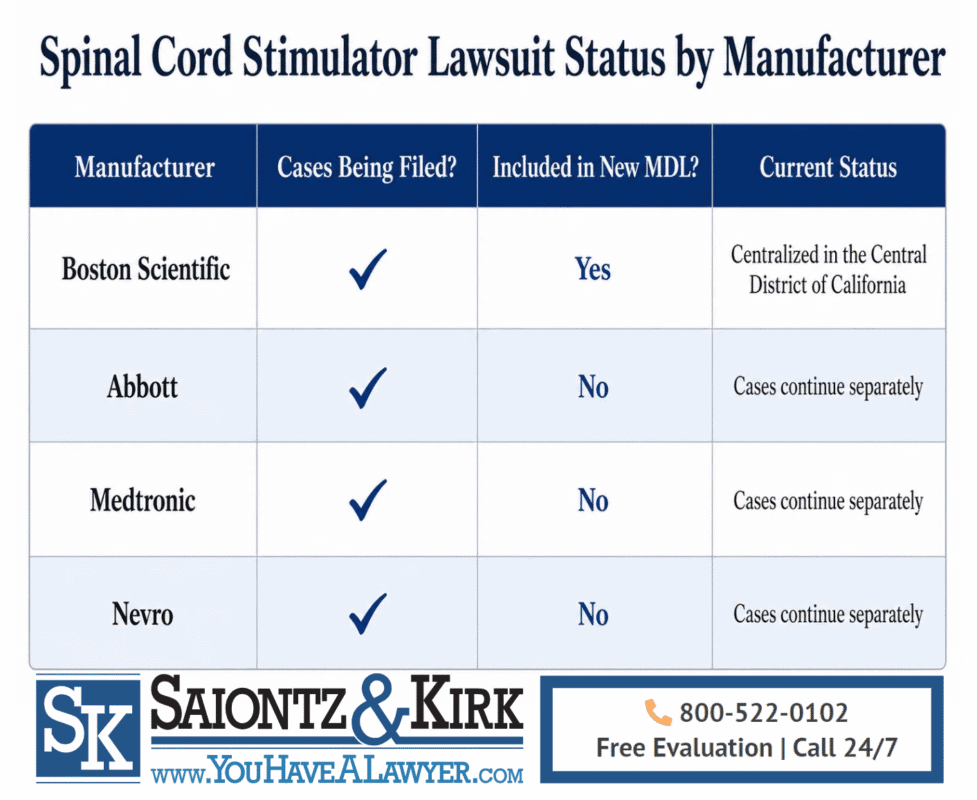
While the decision only gives Boston Scientific lawsuits a central courtroom and a single federal judge to oversee discovery, motions and other pretrial proceedings, it does not shut the door on claims involving other spinal cord stimulator manufacturers.
Our lawyers are still investigating and pursuing similar Abbott SCS lawsuit, Medtronic SCS lawsuits and Nevro SCS lawsuits, which will continue to move forward in state and federal courts nationwide without coordination, at least for now.
Find Out If You Qualify for an
SCS LAWSUIT

Collectively, each of the lawsuits raise very similar allegations that the manufacturers sold dangerous and defective spinal cord stimulators, which caused patients to experience:
- Painful electrical shocks
- Burning sensations or overstimulation
- Loss of pain relief
- Lead migration
- Device failure or shutdown
- Battery or charging problems
- Numbness, weakness or difficulty walking
- Worsening nerve pain
- Neurological injuries
- Revision or removal surgery
As a result of the failure to address known problems with the devices, the lawsuits claim that injured patients should receive financial compensation and spinal cord stimulator settlements to cover medical expenses, pain and suffering, lost income, removal surgery, permanent nerve damage and the long-term impact of living with device-related complications. However, since the questions of fact and law involved in lawsuits against different manufacturers vary, the JPML decided not to create one industry-wide spinal cord stimulator lawsuit MDL.
In this post we will explain why the federal court system centralized Boston Scientific SCS lawsuits at this time, but left lawsuits against Abbott, Medtronic and Nevro out of the MDL, as well as what this means for individuals pursuing compensation.
If you or a loved one experienced complications after receiving a spinal cord stimulator implant and have additional questions, call our law firm toll free at 1-800-522-0102 or complete our free case review form today to find out if you qualify to pursue a claim.
Spinal Cord Stimulator MDL Info On This Page
What Is a Spinal Cord Stimulator MDL?
Boston Scientific Spinal Cord Stimulator MDL Created
JPML Position on FDA as Defendant
JPML Rejects Industry-Wide Spinal Cord Stimulator MDL
Abbott Spinal Cord Stimulator Lawsuits Were Not Centralized
Medtronic Spinal Cord Stimulator Lawsuits Remain Outside the MDL
Nevro Spinal Cord Stimulator Lawsuits Were Also Excluded
Spinal Cord Stimulator Injury Lawyers
What Is a Spinal Cord Stimulator MDL?
A multidistrict litigation, or MDL, is used when many people file similar lawsuits against the same company over the same type of product. Instead of having judges across the country handle the same early legal issues over and over, the federal court system can send those cases to one judge.
That judge does not decide every person’s case at once. Each injured person still has their own lawsuit, based on their own device, medical history, injuries, treatment and damages.
The MDL process is meant to make the early stages of litigation more efficient. One judge can oversee the exchange of company documents, witness testimony, expert issues and key legal arguments that may affect many cases. This helps avoid different courts reaching different rulings on the same issues.
As the MDL moves forward, the court may also select a small group of representative cases for early trial dates, often called bellwether trials. These trials do not decide every claim in the litigation, but they help both sides see how juries may respond to the evidence, the company’s defenses and the injuries alleged by plaintiffs. Bellwether results often help guide settlement discussions and may influence how the remaining cases are resolved.
However, if the lawsuits are not settled or dismissed during the MDL process, individual cases may later be sent back to their original courts for trial.
In this litigation, the JPML created an MDL only for Boston Scientific spinal cord stimulator lawsuits. Claims involving Abbott, Medtronic and Nevro remain active and are continuing to be pursued separately by individuals who suffered serious complications after receiving those manufacturers’ devices.
Boston Scientific Spinal Cord Stimulator MDL Created
On June 5, 2026, the U.S. Judicial Panel on Multidistrict Litigation issued a transfer order (PDF) creating a federal MDL for Boston Scientific spinal cord stimulator lawsuits. The litigation has been renamed In re: Boston Scientific Corporation Spinal Cord Stimulator Products Liability Litigation, MDL No. 3181.
The lawsuits were transferred to the U.S. District Court for the Central District of California, where they will be assigned to Judge Josephine L. Staton for coordinated pretrial proceedings. The JPML found that Judge Staton was already overseeing several coordinated Boston Scientific cases and that Boston Scientific’s neuromodulation division is headquartered in the district, meaning relevant witnesses and evidence are likely located there.
The transfer order centralized the Boston Scientific cases listed on Schedule A, which included lawsuits pending in California, Illinois, Mississippi and other federal courts. The JPML noted there were already 23 Boston Scientific lawsuits pending in nine districts. However, it is widely expected that hundreds, if not thousands of additional claims will be brought in the coming months and years, making centralization the most efficient way to handle overlapping discovery, motion practice and pretrial rulings.
Why the JPML Centralized Boston Scientific Cases
The JPML centralized the Boston Scientific SCS lawsuits because the cases raise many of the same factual questions about the company’s devices, warnings, regulatory history and alleged failure to properly test newer SCS systems.
The lawsuits allege Boston Scientific failed to comply with regulatory requirements for Class III medical devices by relying on published literature involving other companies’ spinal cord stimulators, rather than independent clinical studies showing the safety and effectiveness of its own devices.
Plaintiffs also allege Boston Scientific used the FDA’s PMA supplement process to introduce newer spinal cord stimulator systems with substantial modifications, instead of submitting those devices for more rigorous review and clinical evaluation.
According to the lawsuits, Boston Scientific’s newer SCS systems differed significantly from earlier devices. Plaintiffs claim those changes affected how the implants performed inside the body, while patients, doctors and the FDA were not given complete information needed to evaluate the true risks.
Together, those allegations gave the JPML several common issues that can now be handled by one court, including:
- Boston Scientific’s original FDA approval process
- Use of PMA supplements for newer SCS devices
- Alleged failure to conduct adequate clinical testing
- Alleged failure to warn about known risks
- Device failures and loss of therapy
- Electrical shocks, burning pain and neurological injuries
- Lead migration and other device complications
- The role of Boston Scientific sales representatives in device programming and patient care
The transfer order specifically notes that plaintiffs allege injuries involving unsatisfactory pain relief, shocking, burning, lead migration, autonomic dysfunction and neurological injuries. Although Boston Scientific argued that different injuries and different devices made centralization inappropriate, the JPML rejected that position.
Product liability MDLs often involve patients with different medical outcomes. What mattered here was that the cases shared common questions about Boston Scientific’s conduct, the devices, the warnings, the regulatory history and the alleged failure mechanisms.
Allegations Involving Boston Scientific Sales Representatives
The transfer order also highlights another important allegation raised in the Boston Scientific lawsuits: plaintiffs claim Boston Scientific sales representatives engaged in conduct that amounted to the practice of medicine without a license.
According to the JPML, plaintiffs allege Boston Scientific representatives routinely participated in surgical procedures, advised healthcare providers on lead positioning and stimulation testing, participated in device programming during surgery, provided device setting recommendations and adjusted or instructed the adjustment of device parameters.
This issue is expected to become a major focus in the Boston Scientific MDL. Plaintiffs claim company representatives were not just providing technical support, but were influencing medical decisions that affected how electrical stimulation was delivered to patients’ spinal cords.
JPML’s Position on the FDA as Defendant
The FDA was named as a defendant in more than 30 spinal cord stimulator lawsuits and potential tag-along actions. However, the agency did not support or oppose centralization. Instead, the FDA told the JPML that it had been improperly named as a defendant.
The JPML did not decide whether the FDA should remain in the lawsuits. The Panel’s role was limited to deciding how the cases should be organized for federal pretrial proceedings.
Some plaintiffs allege the FDA failed to meaningfully review the original PMA approvals and later PMA supplements filed by Boston Scientific, Abbott and other manufacturers. However, the JPML found that the FDA’s presence in many cases did not justify one industry-wide MDL, because each manufacturer’s approval history, device changes and regulatory record would still require separate evidence.
The order also noted that FDA-related claims were changing as the litigation developed. Some plaintiffs had voluntarily dismissed FDA claims, while newer lawsuits framed the issue more narrowly as a request to compel the FDA to complete certain administrative processing duties after receiving required safety submissions.
JPML Rejects Industry-Wide Spinal Cord Stimulator MDL
Although plaintiffs who filed the original motion to centralize the claims (PDF) sought broader centralization, the JPML refused to create an industry-wide spinal cord stimulator MDL involving Boston Scientific, Abbott, Medtronic and Nevro.
The JPML rejected one industry-wide spinal cord stimulator MDL because the claims against Boston Scientific, Abbott, Medtronic and Nevro were not identical enough to justify placing every manufacturer in the same proceeding. Although plaintiffs raised similar allegations across the litigation, the Panel found that each company’s cases would require separate evidence and separate analysis.
The JPML pointed to several reasons for rejecting one combined MDL:
- Each manufacturer is a separate competitor with its own spinal cord stimulator product line
- Each company has its own FDA approval history and regulatory record
- The lawsuits do not allege that Boston Scientific, Abbott, Medtronic and Nevro acted together
- Discovery into each manufacturer’s conduct would not substantially overlap
- A combined MDL could require separate discovery tracks and separate motion tracks for each company
- Trade secret and confidential business information could complicate case management
- One industry-wide MDL could prolong the litigation instead of making it more efficient
For those reasons, the JPML centralized only the Boston Scientific lawsuits and left Abbott, Medtronic and Nevro claims to proceed separately for now.
Abbott Spinal Cord Stimulator Lawsuits Were Not Centralized
Abbott spinal cord stimulator lawsuits were included in the original request for centralization, but the JPML denied centralization of the Abbott cases.
The reason was procedural. The four Abbott cases listed on Schedule B were all pending in the Northern District of Illinois. Under the multidistrict litigation statute, cases must be pending in more than one federal district before the JPML can centralize them. Because the Abbott cases before the Panel were all already in the same district, the JPML could not create a separate Abbott-only MDL at this time.
The Panel specifically noted that this denial does not prevent the creation of an Abbott spinal cord stimulator lawsuit MDL in the future, if additional claims are filed in multiple districts. As the litigation continues to grow in the coming weeks, it is expected that a new motion will be filed to centralize the Abbott SCS lawsuits are part of a separate MDL.
Until that occurs, Abbott lawsuits will continue to move forward as individual product liability claims, without coordinated management before one judge. Plaintiffs allege Abbott and its predecessors continued relying on the 2001 FDA approval for the Genesis Neurostimulation System while selling newer Proclaim, Proclaim Plus, Proclaim XR, Proclaim DRG and Eterna systems with substantially different firmware, battery, wireless programming and stimulation features.
Medtronic Spinal Cord Stimulator Lawsuits Remain Outside the MDL
Medtronic spinal cord stimulator lawsuits were also identified as related actions, but they were not centralized in the new MDL.
The JPML order states that six related actions involved Medtronic. However, Medtronic opposed centralization, and the Panel declined to create an industry-wide MDL that would include multiple competing manufacturers.
For now, Medtronic spinal cord stimulator lawsuits will proceed as individual cases outside the Boston Scientific MDL. These claims may still involve similar allegations, including device failure, shocks, lack of pain relief, revision surgery, removal surgery or inadequate warnings. However, the regulatory history, device design, company documents and internal conduct will be specific to Medtronic.
Patients who suffered injuries from Medtronic spinal cord stimulators may still have claims. The fact that Medtronic cases were not centralized does not mean they were dismissed or rejected.
Nevro Spinal Cord Stimulator Lawsuits Were Also Excluded
Nevro plaintiffs asked the JPML to expand the proposed litigation to include Nevro cases and rename the proceeding as a broader spinal cord stimulator products liability MDL. The JPML declined to do so.
The order states that there were seventeen related actions involving Nevro and Globus Medical, as well as one action naming both Nevro and Boston Scientific. However, the JPML found that an industry-wide MDL was not appropriate because Nevro has its own products, regulatory history and company-specific evidence.
Nevro lawsuits will therefore continue separately from the Boston Scientific MDL at this time. Those claims may involve allegations that Nevro spinal cord stimulators caused serious complications or failed to perform as represented, but they will not be part of the Boston Scientific MDL unless a specific case naming Boston Scientific is later transferred through the JPML’s tag-along process.
Spinal Cord Stimulator Injury Lawyers
As the litigation continues to move forward on separate tracks for each manufacturer, the spinal cord stimulator lawyers at Saiontz & Kirk are reviewing claims for individuals who suffered any of the following injuries after receiving a Boston Scientific, Abbott, Medtronic or Nevro SCS pain management device.
- Electrical shocks or jolting sensations
- Burning pain or overstimulation
- Loss of pain relief
- Lead migration or lead fracture
- Battery failure or charging problems
- Device shutdown or loss of therapy
- Numbness, weakness or difficulty walking
- Bowel or bladder problems
- Repeated reprogramming without lasting improvement
- Revision surgery
- Explant or removal surgery
- Permanent nerve damage
Our firm works on a contingency fee basis, which means there are absolutely no out-of-pocket costs to review your case or hire our attorneys.
4 Comments • Add Your Comments
tina says:
i had a scs put in my back in 06/2015 when the dr removed the staples on 7/2015 the dr put me on a nerve burning machine right after the dr did the adjustments for the equipment and turned on the machine i started screaming because i was experiencing sever pain for the leads so the dr stopped the burning machine and made some more injustments in my back and turned the machine back on i was fine until i got home and i turned my machine on and the area for the scs battery started warming up in my back and i started getting sever pain so i turned off the machine and then the next day my back felt really warm to wear it felt almost hot and the was off so i called summit pain management and talked to the nurse then went in to the office the dr act like i was lying but my husband told the dr dont leave this after turning the machine on because it will get warm and cause sever pain he did not listen he put me on the table and then put the equipment on a tester then turned on the machine and walked for a second until i started screaming because it was hurting me so he came shut the scs off and went and dr roth who was in charge of the clinc so they took me into the xray machine to see what was going on they couldnt see nothing so dr roth sent me over to dupont hospital for a valuation and they said the machine was not working right so called dr roth to tell him so i got admitted into the hospital i was having sever pain the machine was still getting warm no pain meds wouldnt help nothing worked so finaly we talked about what to do next so at that time i had to go clear up by indianapolis to see dr trolbridge on august 26,2015 is when the scs finaly was removed then the dr asked me if i wanted the machine deeper i said only if you replace that one he said he couldnt do that so after the dr took the macine out i was still hurting really bad no pills nothing would work or help so i had to go and get alot of pain ful test to find out that my L4&L5 nerves on both sides is completely damaged i have a buligening disk in my shoulders and my lower back my right side is weaker then the left and i had to have a morphine pump put in 12/2025 then a bunch of injections and hospital stays because the pain gets so bad some times
Posted on June 24, 2026 at 1:58 pm
gloria says:
I had that thing ft
Fom2015until 2020 BS WAS ALWAYS ADJUSTIING THIS AND THAT IT NEVER WORKED RIGHT AND THE LAST THREE MONTS I HAS IT DID NOT WORK AT ALLSO I HAD DR RALPH MACEY REMOVE II SAM DR PUT IT IN AT FRYE REGONIAL MEDICAL CECTER I SUFFER WITH CRONIC BACK PAIN EVERY DAY AM 81 YRSOLD
Posted on July 5, 2026 at 3:53 pm
Mollijoy says:
It made it cold not walk recall 69 days after implant I had no bladder bowl control prematurely disabled thanks abbott
Posted on July 7, 2026 at 12:54 am
Mary says:
I had Three put in
I wish I never had it done. I had BURNING ALL OVER MY BODY I WAS SO frightened my Daughter called was put on hold for 2hrs. We was told to contact my Primary DR
MY Primary Dr did not put it in
We was told to cut it off and a Rep would called us that has been almost 48hrs NO PHONE CALL UET.
Posted on September 11, 2026 at 10:28 pm